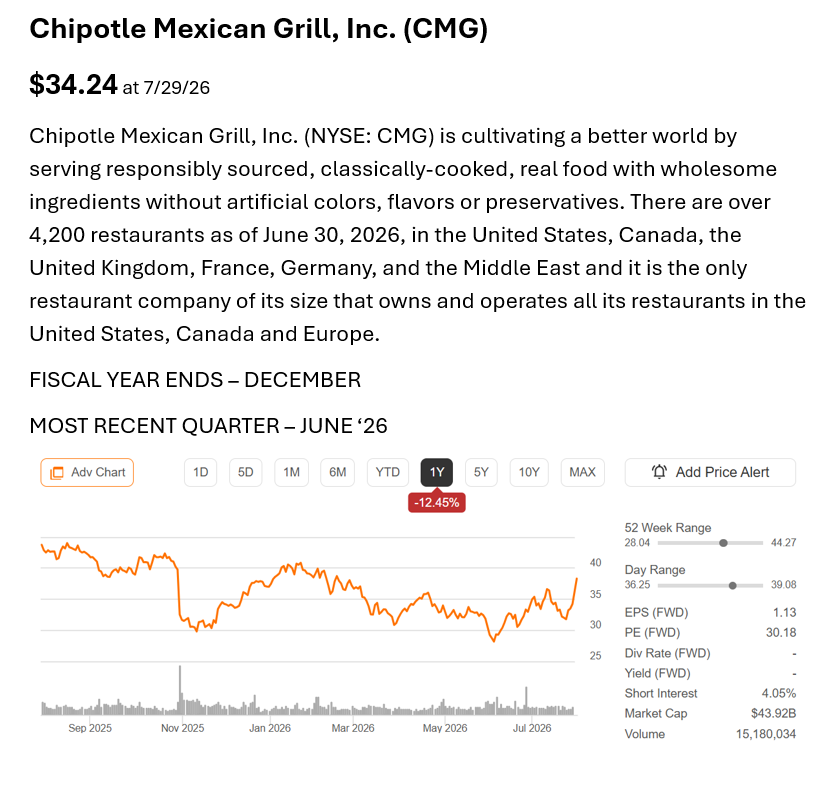
NUMBERS ABOVE per Seeking Alpha
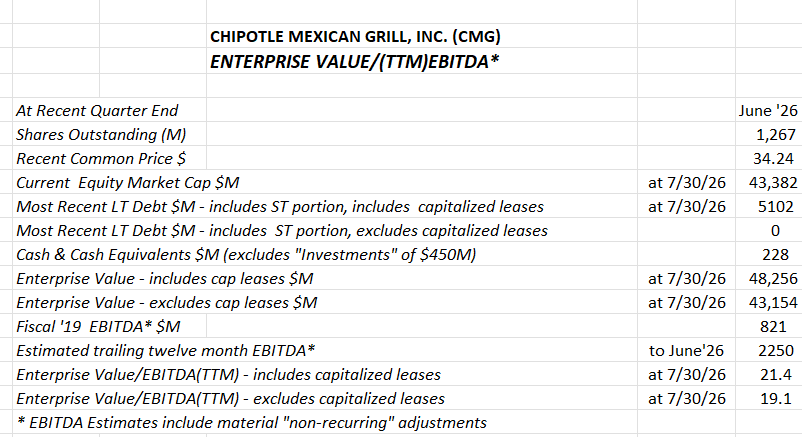
NUMBERS BELOW per Lipton Financial Services, Inc.
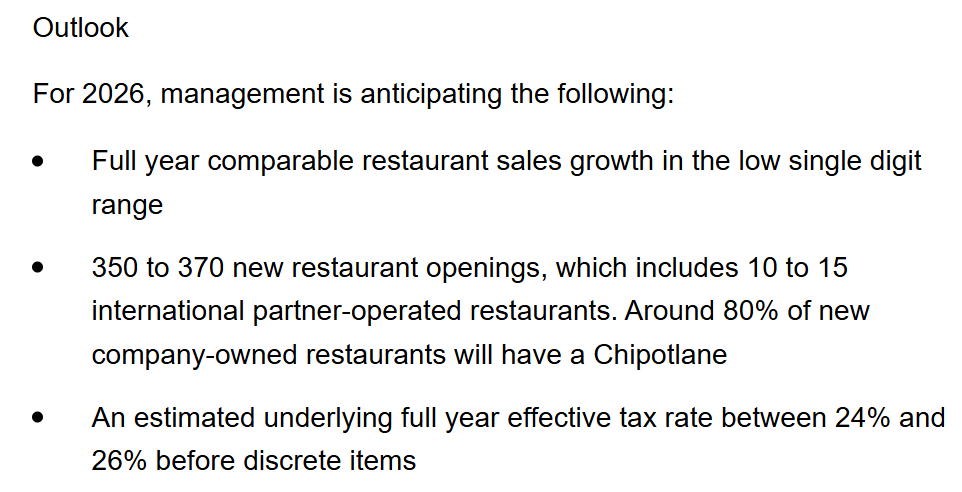
MOST RECENT CONFERENCE CALL TRANSCRIPT & PRESENTATION
Chipotle Mexican Grill, Inc. (CMG) Q2 2026 Earnings Call Transcript _ Seeking Alpha

NUMBERS ABOVE per Seeking Alpha
NUMBERS BELOW per Lipton Financial Services, Inc.
MOST RECENT CONFERENCE CALL TRANSCRIPT & PRESENTATION
Chipotle Mexican Grill, Inc. (CMG) Q2 2026 Earnings Call Transcript _ Seeking Alpha
note: since you received this email, you are obviously a subscriber. DON’T FORGET TO LOG IN, TO ACCESS THE FOLLOWING ANALYSES 🙂
YUM CHINA (YUMC)
https://www.liptonfinancialservices.com/2023/02/yum-china-holdings-yumc-in-process/
CHIPOTLE MEXICAN GRILL (CMG)
https://www.liptonfinancialservices.com/2023/02/chipotle-mexican-grill-cmg-updated-writeup/
RCI HOSPITALITY (RICK)
https://www.liptonfinancialservices.com/2023/02/rci-hospitality-rick-in-process/
NATHAN’S FAMOUS (NATH)
https://www.liptonfinancialservices.com/2023/02/nathans-famous-nath-in-process/
CHIPOTLE
https://www.liptonfinancialservices.com/2022/08/chipotle-mexican-grill-cmg-updated-writeup/
WINGSTOP
https://www.liptonfinancialservices.com/2022/08/wingstop/
TEXAS ROADHOUSE
https://www.liptonfinancialservices.com/2022/08/texas-roadhouse-updated-write-up/
BLOOMIN’ BRANDS
https://www.liptonfinancialservices.com/2022/08/bloomin-brands-updated-write-up/
UPDATED CORPORATE DESCRIPTIONS: ROCKY MOUNTAIN CHOCOLATE (RMCF), DOMINO’S (DPZ), CHIPOTLE (CMG) & CHEESECAKE FACTORY(CAKE)
ROCKY MOUNTAIN CHOCOLATE FACTORY
https://www.liptonfinancialservices.com/2022/06/rocky-mountain-chocolate-rmcf-in-process/
DOMINO’S
https://www.liptonfinancialservices.com/2022/03/dominos-pizza-dpz-updated-writeup-and-conclusion/
CHIPOTLE
https://www.liptonfinancialservices.com/2022/02/chipotle-mexican-grill-cmg-updated-writeup/
CHEESECAKE FACTORY
https://www.liptonfinancialservices.com/2022/03/cheesecake-factory-updated-write-up/
UPDATED CORPORATE DESCRIPTIONS: CHIPOTLE (CMG), CHEESECAKE FACTORY (CAKE), McDONALD’S (MCD), DOMINO’S (DPZ) – with transcripts
CHIPOTLE
https://www.liptonfinancialservices.com/2022/02/chipotle-mexican-grill-cmg-updated-writeup/
CHEESECAKE FACTORY
https://www.liptonfinancialservices.com/2022/03/cheesecake-factory-updated-write-up/
McDONALD’S
https://www.liptonfinancialservices.com/2022/01/mcdonalds/
DOMINO’S
https://www.liptonfinancialservices.com/2022/03/dominos-pizza-dpz-updated-writeup-and-conclusion/
UPDATED CORPORATE DESCRIPTIONS FOR: CHIPOTLE (CMG), RCI HOSPITALITY (RICK), RESTAURANT BRANDS (QSR), YUM BRANDS (YUM), YUM CHINA (YUMC)
CHIPOTLE
https://www.liptonfinancialservices.com/2022/01/chipotle-mexican-grill-cmg-updated-writeup/
RCI HOSPITALITY
https://www.liptonfinancialservices.com/2021/11/rci-hospitality-rick-in-process/
RESTAURANT BRANDS
YUM BRANDS
https://www.liptonfinancialservices.com/2022/01/yum-brands/
YUM CHINA
https://www.liptonfinancialservices.com/2022/01/yum-china-holdings-yumc-in-process/
FOLLOW THE MONEY, with Roger Lipton – Column republished from prestigious RESTAURANT FINANCE MONITOR
We are pleased to announce that we have begun writing a regular column for John Hamburger’s prestigious publication, the Restaurant Finance Monitor. Below is the first installment, published January 15th. We have posted the two pages from the publication at the bottom of this article, but the type is difficult to read so the text follows from here:
FOLLOW THE MONEY ! – WITH ROGER LIPTON !!
Roger Lipton has followed the restaurant industry for 4 decades. Founder of money management & investment banking firm, Lipton Financial Services, Inc., he publishes regularly at www.rogerlipton.com, resume’ available there at “About Roger”. He can be reached at lfsi@aol.com or 212 600 2266.
THIRD PARTY DELIVERY – WHERE ARE WE?
DoorDash has a 50% market share, Uber (with acquired Postmates) is at 33%, and Grubhub at 16% aren’t going away without a fight. DoorDash, Uber, and Grubub have $5B, $7.2B and $466M of cash, respectively, and will no doubt spend aggressively to gain market share. DoorDash is already talking about expanding its service to other consumer categories, probably going to call it an “ecosystem”. All this is taking place while consumer habits adjust, in an unknown fashion, to the post-Covid world. The third party delivery business is still very much in a state of flux. Neither the restaurant owners, the drivers, nor, most importantly, the customers are thrilled with the current model. We expect, as the competition heats up, customers to pay less, the restaurants will pay less, the drivers will get more, and profit margins for the delivery agents will be more likely to shrink than expand. Meanwhile, on Wall Street DoorDash common stock has a market valuation of $44 Billion. In the first nine months of ’20 revenues were $1.9B, up dramatically from $587M, with a loss of $131M (reduced from a $479M loss). Consensus estimates call for $3.8B and $4.8B of revenues in ’21 and ’22, moving to profit breakeven (really?) in ’22. The $44B of valuation is therefore about 9x ’22 estimated SALES. If after tax profit margins could be 10% of sales (which is an above average profit margin) that would make the P/E multiple on “aspirational” ’22 earnings a sky high 90x. It is not the first, or last, time that there is a disconnect between stock market valuations and reality.
PUNCH BOWL SOCIAL – YESTERDAY’S “HOT CONCEPT” GOES AWAY !
Punch Bowl Social. a 24,000 sq. ft. experiential concept founded in 2012 by Robert Thompson was apparently doing about $7M/unit when L Catterton bought into the 9 unit chain in 2015. A short two years later, in mid-2019, with 17 units, Cracker Barrel (CBRL) purchased about 59% of PBS’ economic interest and 49.7% of voting interest, agreeing to provide upwards of $140M. CBRL bought out L Catterton completely and allowed founder Thompson partial liquidity. With a new financially strong partner, Punch Bowl resumed their by now broadened mission to build a “lifestyle brand”. By late 2019, pre-pandemic, after closing a smaller sized location in Fort Worth, weaker performance led to a default on PB’s 2018 loan with CrowdOut LLC., which CBRL settled for $3.5M in January. No doubt the operating strain of rapid expansion of a complex product was becoming all too apparent. By March-April, 2020, with $20M of rent due, CBRL declined to guarantee a first priority loan with CrowdOut. CrowdOut replaced Thompson in August, 2020 with turnaround specialist, John Haywood but bankruptcy was filed in December. A few apparent lessons: (1) Don’t allow your reach to exceed your grasp. (2) Leverage works both ways. (3) Capital is always available when you least need it (4) Zero percent interest rates encourage both equity (Cracker Barrel) and debt (CrowdOut) investors to “reach” for a return. Punch Bowl Social is not the first or last example of “misallocation of capital.” (5) Who suffers now ? Mostly ex-store level employees.
BITCOIN: A PERPETUAL MOTION MACHINE – IT’S A WONDERFUL THING !
The Grayson Bitcoin Trust (GBTC) (to quote Bloomberg LLP) “is an open-ended grantor trust based in the U.S. The Trust’s shares are the first securities solely invested in BTC (Bitcoin).” GBTC is designed to track the Bitcoin price on a daily basis. Here’s the cool thing. GBTC has been selling for approximately a 40% premium to the value of Bitcoins in the Trust. The more shares that are bought by investors, and issued by the Trust, the more Bitcoins need to be acquired so the Trust price can properly track the Bitcoin price. The number of shares in the Trust has steadily increased, from 490,000 in late October to 639,000 as of January 6th. That means 149,000 new shares were issued and, based on the $42.80 price on 1/6, would create a demand for $6.4B worth of Bitcoin. The beautiful thing is that the Trust can use their funds to advertise, attracting new investors to GBTC, which requires more Bitcoin to be bought, which drives the Bitcoin price higher. To be sure, $6.4B worth of Bitcoin buying over a couple of months is not huge these days, and the market value of GBTC, at $27B, is a rounding error within the trillions of “investment” capital that is allocated these days. However, GBTC is growing and incremental buying in any commodity, especially on a regular basis can be Instrumental to increase the price of any commodity. I have written on my website more extensively on this subject. When books are written about the financial follies of the early twenty first century, the rise of bitcoin and thousands of other cryptocurrencies will be one of the ringing bells signifying the imminent bursting of the bubble. In 1620, a lot of smart people believed in tulips.
THE CHIPOTLE RECOVERY – CREDIT BRIAN NICCOL, BUT THE STAGE WAS SET ! – When Brian Niccol was brought in as CEO of Chipotle (CMG) in early ‘18 the stock was in the low 300s, close to its previous low eighteen months earlier in the wake of the norovirus epidemic. CMG has gone almost straight up to over $1300/sh in the last thirty six months. The Company has built its digital and delivery capabilities, introduced new products and controlled labor and food cost well, coming out of the pandemic stronger than ever. Since EPS bottomed at $6.60 per share in calendar ’17, earnings have rebounded and consensus estimates are for $21.21 in 2021 (a new high) and $28.34 in 2022. Great job, Brian ! Taking nothing away from Brian, Scott Boatwright was brought in as Chief Restaurant Officer eight months earlier, in May, 2017. Boatwright had been at Arby’s for twenty years, most recently as Senior Vice President of Operations. The dramatic turnaround at Arby’s is well known by now, and for that Roark Capital (the Private Equity owner) no doubt said “Thank you, Scott”. It’s great, therefore, that Brian recognized talent when he saw it, though he may well have previously known Scott. Together they have led the organization in a great fashion, with Boatwright no doubt the closest to store level operations. Niccol and Hartung (CFO) mostly talk to investors, but it is Boatwright where the rubber meets the road. Lastly, it should be noted that CEO of Chipotle who brought in Boatwright, and to whom Boatwright originally reported, was Chipotle’s founder and visionary, now retired Steve Ells. Perhaps Ells hadn’t lost it completely 😊
TILMAN FERTITTA COULD USE SOME HELP – HOW ABOUT HIS SPACs?
We have described many times how very low interest rates allow for inordinate amounts of debt to prop up companies to a far greater degree than would normally be possible. We’ve followed Tilman Fertitta’s rise to financial prominence ever since his Landry’s Seafood Restaurant chain become publicly held in 1993 with a valuation of $30M. Fertitta has been active ever since. The details between ’93 and ’20 are interesting, and they follow below. The most concise summary is that the 1993 owner of a modest sized group of seafood restaurants 1993 has built over 28 years a huge hospitality company that is coping, in the middle of a worldwide pandemic, with over $4 billion of debt.
Lawyers and accountants and investment bankers working for Tilman Fertitta have made a lot of money in the last 27 years.
Landry’s:
1994 – purchased Joe’s Crab Shack
1996 – purchased the San Luis Resort, a 32-acre beachfront resort on Galveston Island
1998 – developed the 35-acre Kemah Boardwalk
2000 – purchased Rainforest Café
2002 – purchased Saltgrass Steak House, Chart House and Muer Restaurants
2003 – opened the Downtown Aquarium, a 20-acre entertainment complex in Houston, followed by other Aquarium Aquarium restaurants in Denver; Nashville and on the Kemah Boardwalk
2004 – partnered with the City of Galveston to open a 140,000 square foot convention center
2005 – purchased the Golden Nugget Hotel & Casinos in Las Vegas and Laughlin, has since opened three additional locations in Atlantic City, Biloxi, Mississippi and Lake Charles, LA
2006 – sold Joe’s Crab Shack, which had acquired Crab House and Cadillac Bar
In mid-2008, as the economy and credit markets were deteriorating, Fertitta took Landry’s private, acquiring the public’s 61% for $415M and assuming $885M in debt, making for an enterprise value of $1.3B.
The ’08-’09 crisis ran its course, interest rates continued downward and Fertitta did not rest.
2010 – purchased Bubba Gump Shrimp, Claim Jumper and Oceanaire
2011– purchased McCormick & Schmick’s and Morton’s Steakhouse
2012 – expanded entertainment division, opening the Galveston Island Pleasure Pier
2013 – acquired Mastro’s restaurants, has also bought and built Landry’s Signature Group, with Vic & Anthony’s; Grotto; Brenner’s Steakhouse; Brenner’s on the Bayou; La Griglia; and Willie G’s Seafood
2016 – purchased the BR Guest restaurant Group
2017 – purchased, again, Joe’s Crab Shack, having sold it in 2006
2019 – purchased Restaurants Unlimited, adding Skates on the Bay, Portland City Grill, Manzana Grill, Palisade, Cutters Crabhouse, Stanford’s, Henry’s Tavern, Kincaid’s, Palomino Restaurant & Bar, and Portland Seafood Company
2019 – purchased Del Frisco’s for $650 million, selling Barteca
Aggressive enough ?
CURRENTLY – FERTITTA HAS HIS HANDS FULL
Today Landry’s, Inc. owns and operates more than 600 restaurants, hotels, casinos and entertainment destinations in 35 states and the District of Columbia plus numerous international locations.
In spite of a spectacularly successful career in the dining, entertainment and gambling industries, Fertitta is clearly feeling the heat. We are not privy to the gory financial details, but debt, no matter how low the interest rates, can be a problem when an unexpected pandemic takes revenues down by more than 50%, even for a little while.
To demonstrate how quickly fortunes can turn: Fertitta had reportedly paid himself $300M in 2019 and refinanced his company’s debt so no principal would be due until 2023. Moving right along, in late 2019 he was apparently shopping a 49% stake in the Landry’s/Golden Nugget empire. The pandemic hit in March and everyone’s life changed, Fertitta’s not the least. To his credit, he has been open about the strain, said he was a “big boy”, would solve his own problems and not use government PPP funds. He re-invested $50M out of $200M he had taken out in a dividend just a few months earlier and sold $250M in company debt in April at a 15% interest rate.
Most recently, his attempts to refinance have apparently generated interest in the gaming piece, but the restaurants and destination resorts are an obvious problem. A big issue, predictably, is the debt, now about $4 billion, including $1.4B that was spent to buy the Houston Rockets basketball team. The company is apparently generating about $400M of EBITDA currently (pandemic adjusted?). In any event, quoted debt of anything like ten times EBITDA is pushing the capital raising envelope pretty far.
THE FERTITTA SPACs
With all that as background, there are of necessity some large moving pieces right now as Fertitta, said to be worth $5-6B, tries to maintain solvency for his empire. The SPAC space is hot, and enormously productive for aggressive entrepreneurs, so the three SPACs that Fertitta has recently sponsored can play an important role.
The first recent SPAC sponsored by Fertitta, Landcadia Holdings raised $250M in 2016, and ultimately bought a small food delivery company, Waitr Holdings, now trading as WTRH. This relatively small regional player has grown over the last several years, but at a much slower rate than DoorDash, Uber or Grubhub. Revenues in the current fiscal year will be about $209M , up about 10% YTY, and are estimated to grow modestly to $217M and $232M in the next two years. In contrast to most of the the larger players, WTRH has turned profitable, expected to earn $0.17/share this year and $.19 next year. However, the much smaller size and relatively unexciting growth rate has not led to a high valuation. Unfortunately for Fertitta’s near term financial needs, the stock is trading at $3.40/sh, down from the $10 IPO, and way below a price that would help much.
Fertitta’s second SPAC has done well so far. Landcadia Holdings II came public in May, 2019 at $10/unit, raising over $300M. In mid-2020, Landcadia bought the online gaming portion of Golden Nugget and (GNOG) now trades at about $20/share with an $804M market capitalization. Setting aside the pre-merger expenses, GNOG had $55M in total revenues in 2019 with operating income of $17.7M and Net Income after taxes of $11.7M. The valuation is very high, and some observers feel that GNOG is not as attractive as larger competitors such as DraftKing (DKNG, also the result of a SPAC), but the main thing for Fertitta is that the 4.1M shares that the proxy material says he and his affiliates own are worth about $80M, and should be, at least partially, liquid.
Fertitta’s third SPAC, currently looking for an acquisition, is Lancadia Holdings III (LCAYU), which raised $500 million on 10/10/20. Co-Chairman of LCAY, along with Fertitta, is Richard Handler who is currently the CEO of Jefferies, the investment banking firm that has been a constant presence throughout the creation of Fertitta’s empire. As stated, “the company plans to target the consumer, dining, hospitality, entertainment, and gaming industries, including technology companies operating in these industries”. The jury is still out on this one. It remains to be seen whether this SPAC buys into any portion of Landrys.
CONCLUSION:
When I was about to write: “Tilman should write a book.” I checked Amazon and it turns out he has. The title is “Shut Up and Listen! Hard Business Truths that Will Help You Succeed”
I haven’t spoken to Tilman Fertitta in thirty years, haven’t even read his book, so I have no “axe”, but I would not bet against him. His empire would not be easily managed (or efficiently monetized) by anyone but himself. It’s been said: “If you owe the banks a million dollars, you’ve got a problem. If you (in this case) owe the banks four billion dollars they’ve got a problem”. Tilman will lose a lot of sleep, if he hasn’t already, but at the end of the day his company will function long enough for the burden of the pandemic to abate. There are trillions of dollars out there “reaching” for a yield. There will be a price, but some of that capital will most likely reach in Tilman Fertitta’s direction.
As printed in the Restaurant Finance Monitor on January 15th:


BILL ACKMAN, WITH 41% OF ASSETS IN QSR, CMG & SBUX COMBINED, IS STILL NOT WELL POSITIONED
We wrote an article on October 11th, discussing the three major positions in Bill Ackman’s Pershing Square Capital portfolio, within our knowledge base, that comprise a massive 41% of his $8.3 billion portfolio.
At the close of business, October 11th, Restaurant Brands (QSR) was $56.26, Chipotle (CMG) was $434.06, and Starbucks (SBUX) was $54.87. Our conclusion on October 11th was that he should switch his QSR immediately into McDonald’s (then at $163.98), sell his CMG to take advantage of the huge move since new management has been installed, and hold his SBUX (which has moved up nicely).
We have no reason to think that he has made any moves in the last several weeks, but Restaurant Brands, McDonald’s and Chipotle have all reported third quarter results. Starbucks reports tonight.
From the close of business October 11th to last night’s closing price, Restaurant Brands, at 53.06 was down 5.7%, or $85M on the $1.5B position. McDonald’s, at $178.42 was up 8.8%, so would have made Ackman’s Pershing Square Capital a profit of $132M. Chipotle closed at $465 so Ackman would have foregone a profit of 7.1% or $63M on his $900M investment.
Our advice, less than three weeks ago, to Ackman can definitely be considered “theoretical” in terms of the practical ability to switch $1.5B positions instantly, or sell $900M worth of Chipotle on the spur of the moment, and Ackman’s positions are established on the basis of long term prospects. Acknowledging that three weeks doesn’t “make a season” or prove a thesis, Ackman’s portfolio would be ($132M+85M-$63M) a cool $154M better off, or 4.5% of the $3.4B in these three positions, especially costly when all hedge fund managers are fighting for every basis point in a difficult market environment.
Our points here are (1) too many multi-billion hedge funds, and other institutions are playing hunches rather than making well informed long term judgements. This is a function of not enough really attractive reward/risk investment propositions when trillions of dollars of capital are competing to generate “alpha” after nine years of a bull market (2) there is too much emphasis on short term performance, trying to “game” the monthly comps for example, rather than evaluate long term strategic positioning (3) in too many cases, the self confidence of multi-billion dollar money managers is unjustified. They are very smart, hard working, in many cases have become very rich (which breeds inflated egos), and can’t be expected to know as much they should about every industry. Rather than make Bill Ackman an undeserved particular example: Eddie Lampert, still a billionaire, had no chance whatsoever to turn around Sears based on his strategies, and there were lots of highly experienced retailers that could have told him so. It has taken ten years to play out, but it was clear to many of us years ago that the brilliant and successful Lampert was wasting enormous time and money on Sears.
If we were speaking with Ackman today, we would suggest that it’s not too late to adjust the portfolio. The last three weeks are history. Let’s see what happens over the longer term.
Roger Lipton
BILL ACKMAN BETS $1 BILLION ON STARBUCKS – SHOULD YOU FOLLOW HIM?
Bill Ackman’s Pershing Square Management (now managing about $8.3 billion), announced on Tuesday a new billion dollar holding in Starbucks. Typical of his disclosure of major new positions, he made a lengthy presentation at an investment conference. We will get to a discussion of his rationale regarding SBUX, but we’ve followed Ackman’s career, since we’re in the same business (on a much, much smaller scale), and a few highlights will likely be of interest to our readers.
His long term record is outstanding. According to Pershing Square’s website, since inception in 2004 through calendar ’17, the compound annual return, after fees, has been 13.6%, versus 8.7% for the S&P 500 index. However, the really great years were the early ones, when returns from 2004 through 2007 were up 42.6%, 39.9%, 22.5% and 22.0% respectively. The year’s 2007 through 2014 were still good, though not as spectacularly consistent, down 13.3%, up 40.6% (must have been short in 2008), up 29.7%, down 1.1%, up 13.3%, up 9.7%, up 36.9%. The last four years, from 2015 through 2018 have been disappointing, down 16.2%, down 9.6%, down 1.6% and up something like 10% YTD in ’18.
Ackman has made some spectacularly big gains, since he makes big bets, and has had equally impressive losses. Among his largest gains have been MBIA, General Growth Properties, Platform Specialties, and Restaurant Brands (which is an outgrowth of his holdings in Burger King and Tim Horton’s, which merged). His losses have included JC Penney, Target and Valeant. He become a household name with a well publicized short position in Herbalife a few years ago, and finally exited the position after an extensive and expensive campaign to put the company out of business. Ackman’s brilliance and tenacity are unquestioned. One could question, however, whether any money manager has the right to personally decide whether a company deserves to be in business. It’s one thing to announce a short position. It’s another to take it upon yourself to contact bankers and employees and anyone else you can find (in the case of Herbalife: their sales network) in an effort to discredit the organization.
Which brings us to Ackman’s current large bets within the universe that we know pretty well, namely his positions in Restaurant Brands (QSR), Chipotle (CMG), and, most lately, Starbucks (SBUX). His $8.3 billion portfolio is down quite a bit from $18.3 billion in 2015, no doubt due to his lackluster performance lately. His CMG is worth about $900M, his SBUX is worth about $1 billion, and his QSR is worth about $1.5 billion. These three positions, therefore, represent a total of about 41% of his $8.3 billion portfolio.
In summary, we don’t think this major portion of his portfolio will outperform the general market, or even the restaurant industry in general.
Regarding Restaurant Brands (QSR), by far the largest of the three positions: We’ve written extensively, which readers can access through our Home Page. In a nutshell, the stock is more than adequately valued, since the largest contributor to their EBITDA, Tim Horton’s, is a troubled chain, Popeye’s is too small to move the corporate needle much, and Burger King, though it has performed well under QSR’s leadership, continues to operate in a very competitive burger segment. The “low hanging fruit”, that was opportunistically picked by the QSR financial engineers, is gone, so the earnings progress of the past won’t be duplicated from this point forward. We refer readers, again, to our previous more extensive discussions. A heck of a case can be made, in terms of the fundamentals and the relative valuations, that QSR should be switched into MCD immediately.
Regarding Chipotle (CMG), still almost $1 billion holding, Ackman’s original position, taken a couple of years ago, in the 400s, after falling to a low of about $260, has come back to a profitable point, and Ackman’s has exited about 25% of his position. We wrote, a couple of years ago, that he had no “edge” relative to his knowledge of CMG. There was no undervalued real estate, or other opaque asset that could be monetized. His opinion was no better than yours or mine whether the brand could, or would, regain its previous popularity. Ackman has gotten lucky, because CMG has run back to $440 today (was briefly over $500 in mid ’18), and he is more or less even on the position. The huge move in the stock has more than adequately anticipated the fundamental recovery, now selling at over 50x ’18 EPS, and 27x trailing EBITDA. It is three full years since the crisis of ’15, and same store sales are only up by single digits against easy comparisons. Backing out menu price increases, traffic has barely improved from the lows. Further backing out the progress with their mobile app, in store dining traffic is still less impressive. Suffice to say: CMG, still challenged, is no bargain at current levels.
Regarding Starbucks (SBUX), the most recent purchase. Once again, we have written extensively on this situation, which we encourage you to access with the Search function on our Home Page. This is a great worldwide brand. They will continue to grow, especially in China. They will continue to buy back billions of their own stock. However: the future growth will be slower than in the past, so the price/earnings multiple is unlikely to expand, which Ackman is counting on. Ackman has discovered that Starbucks is selling caffeine, and we’ve pointed out many times that selling an addictive product is a significant corporate advantage. (Maybe that’s why Constellation Brands, STZ, has invested $4 billion, for a 38% in Canopy Growth, CGC, a cannabis company with a market cap of $10B, over 20x ’19 estimated sales.) However, back at SBUX, food sales are about 25% of sales, so, backing out the increase in food sales, caffeine sales are down over the last couple of years. In a nutshell, as in the case of his CMG purchase, he has no edge. His argument that the valuation of SBUX, in terms of earnings and cash flow, is well below the long term average, that is almost inevitable when growth expectations are less than was the case historically. Ackman expects SBUX to double in price over the next three years. Since the earnings per share will likely not grow at more than a mid-teen rate, even including stock buybacks (don’t forget the rising labor costs), he is counting on valuation expansion, which we consider unlikely. Having said all that, we consider it unlikely that he will lose money on this position over the next several years. Starbucks is a very strong company. It will just not be as profitable as he hopes.
In summary:
We don’t expect that Ackman’s performance, nominally and relatively, will improve by way of the above 41% of his portfolio. Starbucks is unlikely to do any major damage, but Restaurant Brands is substantially overvalued. He should switch immediately into McDonald’s or something else. He should consider himself lucky if he can exit Chipotle in one piece. From a broader standpoint: If this is the best Ackman (a very smart guy) can find in the marketplace today, it is not a good commentary on the state of the market. situations.
Roger Lipton