


We have for some time been predicting that the annual US deficit for the year ending 9/30/26 would be well over $2 trillion, up hundreds of billions from $1.78 trillion in the Y/E 9/30/25.
We were wrong! Well, not exactly.
The US government reported deficit for the fiscal year ending 9/30/26 turned out to be $1.99 trillion, up “only” $210 billion from $1.78 trillion 9/30/25.
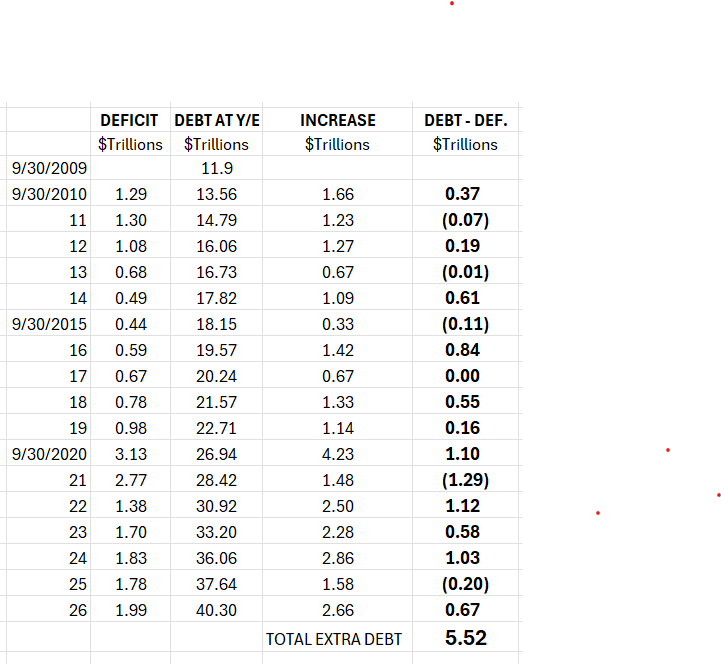
However, the total Y/E debt was $40.30 trillion, up $ 2.66 trillion from $37.64 trillion at 9/30/25. The debt therefore grew an “extra” $670 billion in excess of the reported annual “deficit”. Only with governmental accounting can this discrepancy exist. Turns out that the extra expenditures were “borrowed” from a variety of governmental agencies, the most conspicuous being the Social Security “lockbox”. This of course means that the Social Security funds will fun out sometime earlier in the 2030s than has been assumed.
This situation is not “one off”, the difference is material, and the result is discouraging. It happens most years that the debt grows more than the operating deficit would indicate. The table below shows the last fifteen years, and the cumulative “extra” spending, and higher debt load amounts to $5.52 Trillion. People: this is real money!
No matter what President Trump, Treasury Secretary Scott, Fed Chairman Kevin Warsh, or either political party tells you, this situation will not improve materially. Seventy five percent of the U.S. annual spending budget is accounted for by entitlements such as Social Security, interest on the debt and defense spending, all of which continue to rise at least as fast as GDP and/or inflation. To come close to balancing the budget, every other governmental agency (education, transportation, etc. etc.) would have to be eliminated. The inevitable result is that: What you see is what you get!
It’s been said that “those who ignore history do so at their own peril”. Within the next week we will present a concise long term (100 year) summary of the fiscal/monetary follies (led by the USA) that have led to the current situation, providing a compelling case that stagflation is the best possible outcome for the foreseeable future. The politicians, worldwide, will not get together to implement meaningful reform until they have no other choice.
Roger Lipton