


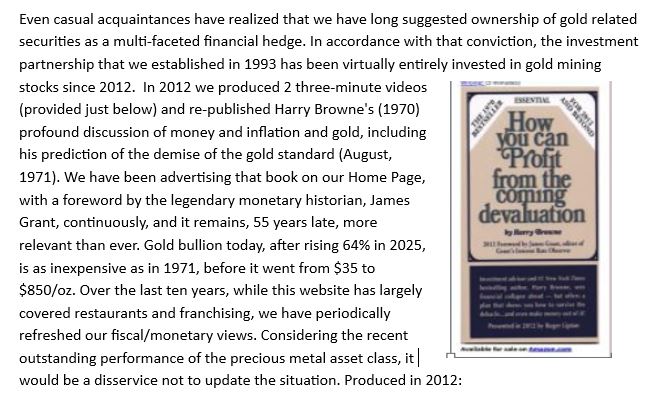
TWO THREE MINUTE VIDEOS: back in 2012:
https://www.youtube.com/watch?v=1ebZO5iMNeg
https://www.youtube.com/watch?v=ah7Y2rHuhCs
The following is our 2025 year-end letter to Investing Partners of our Limited Partnersrhip. We emphasize that past results should not be considered as indications of future expectations. While the Partnership remains open to new investors (with a minimum investment of $500,000), we caution that this presentation is not to be considered a solicitation, which can only be provided by way of an offering circular.
Memo to: Investing Partners January 1, 2026
It was a relatively quiet month in both equity and bond markets. Gold bullion, after retreating from an intra-month high, finished ahead 1.9% for December, up 63.7% for the year. Our portfolio was up 6.0% in December, and 155.2% for the full year. While the gain is impressive, we believe that gold bullion has a great deal more upside ($10,000 or more. over several years), and the valuation multiples on the mining stocks are almost as inexpensive as they were a couple of years ago. It is worth noting that we now also have a modest position in gold’s “little brother”, silver. It’s hard to say that we are still in the second inning of our long-term game, so let’s call it the bottom of the third. As we reap some of our hard-earned rewards, we’ve tried to provide below some the of driving principles behind our strategy. As we say below: “We don’t make this stuff up.”

A great deal of the following discussion has been provided on a monthly basis over the last dozen years. Since virtually the whole situation remains as it was then, only more extreme, it seems useful to review some of the principles.
Most concisely stated, a sound economy requires a sound currency. We consider ourselves “Austrian Economists”, rather than “gold bugs”, depending on a “hard”, currency (with issuance limited one way or another) so that the politicians cannot (predictably) dilute it into oblivion. Throughout history, convertibility into gold has proven to be the most productive approach, due to its physical durability, acceptability, and limited availability. As monetary historian, James Grant, has said, “a gold standard is not perfect, but it is the least imperfect”. Conversely, there has never been a fiat currency that has survived, and the US Dollar will not be the first. A 1913 Dollar, when the Federal Reserve was established (to control inflation) is worth about $.02 today, and you can draw your own conclusions from here.
Within that context, I provide you just below with a three-minute video that I produced in 2012, describing our fiscal/monetary environment.
https://www.youtube.com/watch?v=ah7Y2rHuhCs
Looking at it another way, Austrian Economics is largely the other side of the Keynesian Economics coin. John Maynard Keynes, a brilliant economist who came into prominence in the 1920s argued that the US government’s Federal Reserve “independent” agency, could smooth out what had become bothersome economic cycles. They could supply funds in tough times and withdraw them when the economy improved. That could theoretically work, but the politicians throughout history never have the discipline to allow for the funds to be withdrawn when the economy improves. The money supply therefore moves inexorably higher, stimulating the long-term inflation that destroys the public’s purchasing power, especially within the lower and middle class. The politicians never discuss the fact that the “Wealth Gap” has been an increasingly thorny problem ever since the early 1970s, when the US went off the gold standard, inflation accelerated, and this situation persists to this day.
With that prologue, below are just a few of the many contributions that have shaped this money manager’s view, and to which you have been subjected for so long. (I really don’t make this stuff up!)
- Leviticus, the third book of the Old Testament (Torah), provided laws, rituals, and holiness codes for ancient Israel after their Exodus from Egypt. Within the instruction: “You shall do no injustice in judgement, in measurement of length, weight, or volume. You shall have honest scales, honest weights….(We say “you can’t have a sound economy without a sound currency.”)
Since the Old Testament and within my investment career have been quite a few additional worthy commentators. For example:
- George Washington, in 1787, warned that “The first problem with money printing is the door it immediately opens for speculation, by which the least designing, and perhaps most valuable, part of the community is preyed upon by the more knowing and crafty speculators.” Apparently, the money printing that took place starting in 1791 stimulated schemes and speculations by which “multitudes of small fortunes were absorbed and lost, with a few swollen fortunes aggregated in the larger cities”.
- Ray Dalio, billionaire and legendary money manager, recently issued a stark warning regarding the future of global finance, asserting that all major fiat currencies are “in trouble” due to unsustainable debt loads. He predicts the world is entering a period of significant currency devaluation comparable to the 1930s and 1970s. “When governments accrue insurmountable debt—such as the United States’ current $38 trillion burden—they are eventually forced to devalue the currency to service those liabilities.”
Since a picture is worth a lot of words, the following chart illustrates over the last 234 years, since Alexander Hamilton established the Coin Exchange Act with only gold and silver as legal tender, what has happened to the price of commodities priced in gold versus US Dollars.
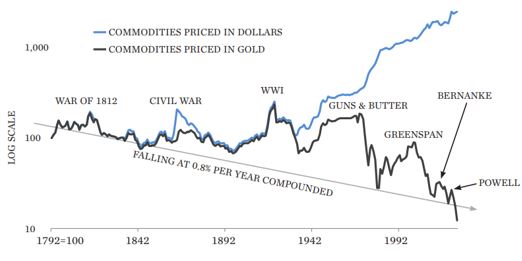
You can see that both lines were virtually flat, without inflation, with the exception of the money printing periods during the War of 1812 and the Civil War. The lines began moving upward after the Federal Reserve was established in 1913, spiked upward together during and after World War II, and moved in tandem until the late 1960s (Lyndon Johnson’s Guns & Butter “Great Society). The lines especially diverged after that with the money printing by Greenspan, Bernanke and now Jerome Powell. The conclusion is inescapable that the diverging lines will continue, as consumer purchasing power is diluted away. It is with this in mind that we continue to hold securities backed by precious metals.
With all that we have discussed above, there is every reason to think that the future will mirror the past in terms of money printing, inflation, the dilution of the public’s purchasing power and the continuing utility of gold related securities as a safe haven. Just a couple of weeks ago, the Fed restarted QE, only this time they are calling it reserve management purchases (RMP). Bernanke’s initial QE, announced in November 2008, was $600 billion, which was mind boggling at the time but RMP is open-ended, commencing at $40 billion per month. The Fed says the pace of printing will slow after a few months, but Bernanke said it would be necessary to return the Fed’s balanced sheet to its pre-QE size. Because the monetary “addict” requires an increasingly large “hit” to maintain the ‘high”, we expect that the money printing will accelerate. The only hope for civilization is “liquidation”, not just of the debt but the Fed and the present currency system. This process is already taking place, without the US government’s blessing as gold returns to its role of balancing trade and being the preeminent reserve. Individuals are also beginning to put themselves on a “gold standard” as they accumulate gold bullion, mining stocks, ETFs such as GLD and others backed by gold and other non-Dollar denominated assets.
All of this should be productive for our portfolio. As always, we are available to discuss your thoughts, questions or concerns. Have a healthy and happy New Year!
Sincerely,
Roger