



We have written extensively about the One Group, which can be accessed by way of the SEARCH function on our Home Page. The Company capsulized: As of September 28, 2025, the Company operated, managed, franchised or licensed 157 venues, including 29 STKs, 85 Benihanas, 23 Kona Grills and 14 RA Sushis in North America, Europe, Latin America and the Middle East, and 6 food and beverage venues in three hotels and casinos in the United States and Europe.
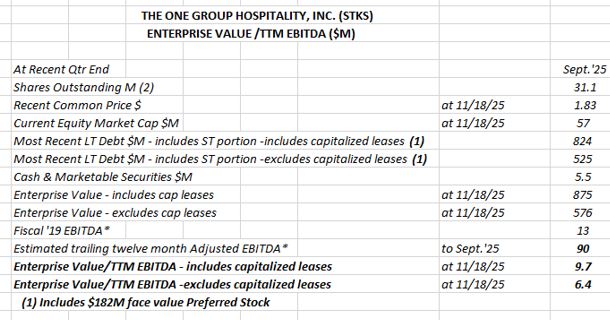
CONCLUSION: While the STK chain remains highly productive for The One Group, Benihana, purchased 18 months ago, is the largest sales and cash flow contributor to total results and continues to be the potential “multiple maker”. In the wake of Q3 operating results Company guidance in terms of Adjusted EBITDA for calendar 2025 has been scaled back by about 7.5% at the midpoint, but the long-term potential seems unaffected. With a current Enterprise Value at a modest 6.4x 9/30/25 TTM EBITDA, with the management, cash flow and balance sheet in place to support substantial growth, the upside potential for STKS seems substantial. With 90M of currently trailing EBITDA spread across only 31M shares of stock, every one point increase in the EV/EBITDA multiple is worth almost $3/share of appreciation.
THE THIRD QUARTER OF 2025
The One Group Hospitality (STKS) continued to make progress within a challenging environment against long term objectives. Traffic was positive for the second quarter in a row at company owned STK locations. Though Benihana felt some geographical headwinds in Q3, new full-sized locations have opened very well and franchise interest is said to be building for Benihana Express.
THE THIRD QUARTER
While Q3 is typically a relatively slow quarter, this year was impacted further by external factors that temporarily reduced traffic among target demographics. While Cost of Goods continued to be well controlled (up a modest 20bp), rising commodity costs outpaced pricing adjustments, putting unexpected pressure on profitability. Below the operating line were several non-recurring items, notably Transition and Integration Expenses ($2.6M), and most notably an increase in income tax expense of $64M primarily related to the establishment o a non-cash tax valuation allowance and a non-cash fixed asset impairment charge of $3.4M attributable to Grill restauants.
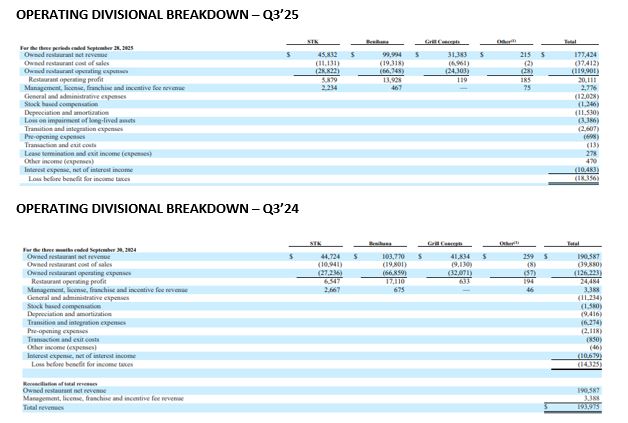
GAAP Revenues were down 7.1% to $180.2M due to lower same store sales (5.9% overall at Company stores) and Management, License, Franchise and Incentive Fee revenues down $819k to $2.8M. Though traffic was up at STK for the second quarter in a row, comparable sales were down 6.2% and 4.7% respectively at owned and franchised STKs, down 4.0% at Benihana and down 11.8% at Grill Concepts.
Across all Company operated restaurants, Cost of Sales was up 20 basis points YTY to a well controlled 21.2%. Obviously affected by the industry wide weaker sales, other store Operating Expenses (including labor) were up 140 basis points to 67.6%. Overall store level operating margin was down 150 basis points to 11.3%. Cash generated at the store level was $20.1M, down from $24.5M, virtually the same decrease as Corporate Adjusted EBITDA.
Cost of Goods Sold (CGS) and Other Operating Expenses (including labor) by concept were: at STK 24.2%, down 30bp YTY and 62.9%, up 200 bp respectively. Benihana ran 19.3% CGS, up 20bp, with 66.7% Labor and Other, up 220bp. Grill Concepts ran 22.2 CGS, up 40bp, and 77.4 Other, up 70bp. Store level margin was 12.8% at STK, down 180bp, 13.9% at Benihana, down 250bp, breakeven at Grill Concepts, down 150bp. No question that lower sales took its toll.
General and Administrative Expense was $13.3M, up from $12.8M in Q3’24. Company Adjusted EBITDA was $10.6M, down $4.3M from $14.9M. Without detailing all the items, the decline in store level profit margin was most responsible, coming in with the same $4.3M decline. It is worth noting that Benihana continues to provide the lion’s share of company EBITDA (69%), slightly higher than the 66.8% of Q2. The Grill, on the other hand, continues to be a work in progress, most recently only breaking even on a store level basis.
OPERATIONAL DEVELOPMENTS – IN SUPPORT OF EXPANSION PLANS
Management continues the effort to streamline the portfolio. Having closed six underperforming locations this year, five in the second quarter and one in the third, they now plan to convert up to an additional nine Grill units to either Benihana or STK formats by the end of 2026. Additionally, the first RA Sushi to STK conversion opened in October in Scottsdale, Arizona. These conversions take approximately eight to twelve weeks with a suggested payback period of approximately one year. Once all conversions are complete, management expects that all Grill units will be profitable. They also expect to reduce capital expenditures across all brands in the coming year, enhancing general financial flexibility. CEO, Manny Hilario, states that the “Benihana integration continues to exceed our expectations and the new Benihana prototype is delivering strong results. During the second quarter, we opened our second franchised Benihana Express location, validating our asset-light growth strategy.”
Management’s commentary (below) within the conference call was encouraging. Since all stakeholders care about short term results as well as long term plans, it is notable that early fourth quarter sales are said to be improved and early holiday bookings are promising as well.
Per the conference call: Management described a long list of sales and margin building initiatives.
- Menus at all concepts are being broadened to appeal to more frequent dining occasions, as well as value-driven consumers, as well as reducing exposure to price sensitive commodities such as certain types of seafood.
- The Friends with Benefits loyalty program continues to gain momentum with over 6.5 million members, adding over 200,000 new members just in Q3, with newly enrolled guests showing the most repeat participation in the program.
- All brand websites have been upgraded to feature fresh, mobile-optimized designs that are increasing both traffic and conversion rates.
- Capital-efficient (“asset light”) growth has been prioritized. The newly redesigned Benihana location opened in San Mateo, California, early this year was the best opening in the brand’s 60-year history.
- A Benihana design improvement has relocated the sushi station to the back of the house to create more table capacity, expanded the bar seating area, modernized the interior with a brighter more contemporary look, and created a dedicated takeout station that improves overall restaurant flow. They have added 2 to 3 tables per restaurant to create meaningful capacity increases that directly boost revenue potential. This should allow future locations to do $8M annually with a restaurant-level profit margin in the mid-20% range.
- Franchise momentum continues to accelerate, with two Benihana Express locations now open and more in development. The Express format offers the full menu without Teppanyaki tables, is generating strong franchise interest that supports asset-light expansion. Over time, management expects franchise licenses and managed locations to represent over 60% of the total Benihana footprint.
- Benihana is also expanding into more nontraditional venues, currently operating in 3 professional sports stadiums, generating 9 million fan impressions annually, with additional airport and arena opportunities under discussion.
- Summarizing unit expansion, they have opened 4 company-owned venues and 1 franchise location year-to-date, with additional fourth quarter openings planned, bringing the total 2025 openings to 5 to 7 new venues. In Q4, already opened is an STK in Scottsdale, Arizona, with a company owned STK in Oak Brook, Illinois, and a Kona Grill San Antonio relocation still to come.
- Relocations remain a key strategy to unlock strong returns in existing markets. For example, the recently relocated Westwood STK has delivered margin improvement over the previous location. Remodels are also showing promising results. During the third quarter, the outdated Tampa Bay Kona Grill was remodeled with modest capex, delivering a significant sales improvement.
- Portfolio optimization consisted of a thorough evaluation of the Grill portfolio in particular, closing 6 underperforming locations in the second quarter and 1 additional location in the third quarter. Furthermore, 9 additional Grill locations will be converted to either Benihana or STK formats through the end of 2026. The $1 million in conversion cost can pay off quickly since the average new STK generates over $1 million in annual EBITDA, The first conversion of a RA Sushi location to an STK location opened in Scottsdale, AZ at the end of October. After completing all planned conversions, all should be profitable and generating in total over $100M in revenues and $10M in store level EBITDA.
- Balance sheet flexibility remains critical. With approximately $45 million in liquidity, they have the means to invest in disciplined growth. The Board authorized a $5 million share repurchase program last year, most of which is still in place. Additionally, they expect to further reduce discretionary capital expenditures in the coming year. Worth noting is that STKS carries a 13% preferred stock (originally $150M), non-callable until May ’27, that was put in place to purchase Benihana. While interest has been Paid In Kind, the Company looks forward to the refinancing of this issue at a substantially lower interest rate.
CALENDAR ’25 GUIDANCE HAS BEEN ADJUSTED – FWIW, FOURTH QUARTER SIGNS ARE STRONG
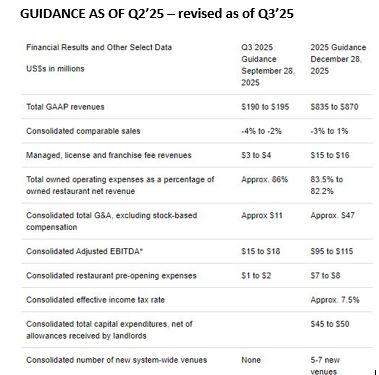
Reflecting the Q3 shortfall, management has adjusted previous full year guidance (shown below). Revenue now is expected at $820 to $825M. Comp sales are now expected from -3% to -2%. Fee Revenues at $14-16M. Operating Expenses should be approximately 83.5%. Total G&A at about $46M. Adjusted EBITDA at $95-100M (about a 7.5% reduction at the midpoints, again reflecting the slow Q3) Pre-opening expenses at $5-6M. Income tax rate, excluding the impact of the valuation allowance, at 1%-4%. Capex at $45 to $50M. Consolidated number of new venues remains the same at 5-7.
Overall, management has adjusted the year largely reflecting the unexpectedly slow Q3. It appears that they are sufficiently encouraged with the start of Q4 and holiday bookings they have not revised their previous Q4 expectations materially.
With guidance adjusted appropriately, we view management’s Q4 optimism as credible, especially considering that almost half of Q4 is history and early holiday bookings are in hand. As CEO Hilario put it: “We are better positioned than ever to capitalize on that (fourth quarter) strength. 2024 marked our first holiday season with Benihana in the portfolio, and we set records across every holiday with exceptional demand. This year, we have made targeted investments to capture even greater holiday demand. Our enhanced reservation technology, streamlined operational flow, and comprehensive team training initiatives position us to execute flawlessly during our busiest periods. A key operational focus is optimizing Benihana table efficiency. We are targeting a reduction from 120 minutes to 90 minutes table turns throughout the fourth quarter, which will significantly expand our capacity to serve more guests during the busy dinner periods. The items that I have outlined today are fundamentally execution-driven and within our direct control. We are not relying on macroeconomic recovery or waiting for consumer sentiment shifts.”
APPRECIATION MODEL FOR STKS – FROM 2025 TO 2028
We published in our April ’25 the following table, providing our rough model for possible performance over the next several years. Long term guidance from the Company has not changed, and other than a starting point at 12/31/25 that is now about 7.5% lower, we know of nothing in the outlook that would materially change the potential. The numbers are self-explanatory, and provide upside possibilities, which are especially attractive relative to the modest downside risk from the current level. While the fundamental starting point of EBITDA is 7.5% lower, STKS equity is priced 30-35% lower. As we see it: without materially greater risk, the upside multiplier has been increased. We plan to update this long-term model once calendar ’25 results have been reported.

CONCLUSION: Provided at beginning of this report.
Roger Lipton