



THE ONE GROUP HOSPITALITY, INC. (STKS)
SUMMARY AND CONCLUSION
Management of STKS has performed admirably with their “vibe dining” experiential concept, the 30-unit chain of STK Steakhouse, improving same store over 50% between 2019 and 2024, using their $11.3M AUV (on latest openings) to earn an average 62% cash on cash return. The acquisition of Kona Grill in 2019 has also produced admirable results, at this point having returned cash in excess of its purchase price. Most importantly…the purchase in May ’24 of Benihana restaurants promises to be a “game changer”, more than doubling both system-wide revenues and Adjusted EBITDA to about $1 billion and over $100M respectively. At this point Benihana and STK each provide substantial growth opportunities, the franchising opportunity at Benihana representing an especially interesting “wild card”, or, in stock picker parlance, a “multiple maker”.
We should not forget that STKS also manages, licenses and franchises the STK and Benihana brands and performs Food & Beverage hospitality management services, marketed as ONE Hospitality, and include: developing, managing and operating restaurants, bars, rooftop lounges, pools, banqueting and catering facilities, private dining rooms, room service and mini bars tailored to the specific needs of high-end hotels and casinos. They generate management fees based on top-line revenues and incentive fee revenues based on a percentage of the location’s revenues and net profits. While a material, and steady contributor to corporate results, roughly $15M of revenues annually, this asset-light cash generator grows in an opportunistic fashion, rather than by predictable unit expansion.
The current Enterprise Value of STKS is only about 5x the Company’s estimate of calendar ‘25 Adjusted EBITDA, which we consider modest considering the apparent long term growth opportunity for both STK and Benihana. However, opportunity knocking is rarely as simplistic as it appears. Within that context we believe that the concerns (outlined below) are overblown and will fall by the wayside over the next year or two. Our suggestion in this regard is to “keep your eye on the prize”, 24-36 months away, as earnings and cash flow grow, debt comes down, and operating performance drives a re-rating of STKS equity.
Each brand’s history, unit level economics, and opportunity for growth will be described below, but “the story” and the current valuation, in our view, is likely clouded by (1) The STK brand, impressive as its results have been, has been running a negative comp for the last year or so, and its relatively high average ticket of about $130pp could be considered as vulnerable (2) Kona Grill, though cash flow since acquisition has more than paid back its purchase price, has suffered double digit negative comps lately, predictably affecting store level margins, and putting unit expansion essentially on “hold” (3) recently purchased Benihana, while tremendously promising, has not had time to demonstrate its cash flow generation and growth potential, including its franchisability (4) Investors can’t love the 11.8% interest rate on $350M of long term debt, or the 13% dividend on $160M of Preferred Stock (which is not refundable until May ’27) (5) Especially prior to the purchase of Benihana, STKS has traded in the small-cap stock universe, with under $400M of annual revenues, therefore of limited interest to major investment banking firms and their institutional investors that need larger positions than STKS can provide.
In conclusion…….
The current Enterprise Value of only about 5x estimated ’25 Adjusted EBITDA combined with the prospect of that EBITDA doubling over the next five years, and compounded by the financial leverage could provide investors with a “ten bagger” (using Peter Lynch terminology). Considering (1) management’s demonstrated capability by way of their performance with STK and Kona Grill (2) the continuing growth prospects for STK (3) the long-term credibility and remaining relevance of the Benihana brand (4) the Company’s apparent ability to comfortably meet current debt obligations and reduce the same over time: we consider the risk of material fundamental disappointment relatively low, which, combined with the substantial upside possibility, provides an unusually attractive investment opportunity.
THE HISTORY
STKS came public about twelve years ago, when it was merged with a Special Purpose Acquisition Company (SPAC), the initial price being $5.00 per share The stock languished, trading under $2.00 per share by 2017, as operating performance was uninspired. The company’s fortune turned when Emanuel (“Manny” Hilario became a member of the Board in April, 2017, then appointed President and CEO in October 2017. In October 2019, six months before Covid hit, STKS acquired (out of Kona Grill’s bankruptcy proceeding) 24 domestic restaurants (about half of Kona’s peak size), for a contractual price of $25.0 million plus approximately $1.5 million for the apportionment of rent and utilities and approximately $7.7 million in current liabilities at the time.
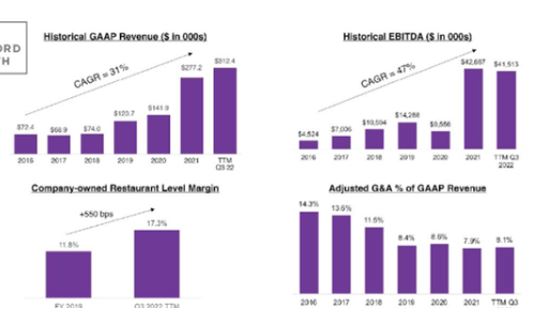
Hilario’s leadership has produced impressive progress. Corporate Adjusted EBITDA, which was $5.4M in ’17, grew to $9.1M in ’18, $13.7M in ’19, fell to $9.4M in COVID-depressed ’20, exploded to $41.7M in’21, was $35.7 and $32.8 in ’22 and ’23 as new store development ramped, and increased to $75M (with Benihana for 8 months) in calendar ‘24. Adjusted EBITDA in ’23 and ’24 was negatively affected by lower comps at STK and especially at Kona, against the very difficult comparisons of ’21 and ’22 and the economy-wide inflation affecting COGS and labor. On the positive side, it is worth noting that comps have improved sequentially the last two quarters at STK, with positive traffic in Q4’24 and early results at Benihana have been promising. Adjusted G&A as a percentage of GAAP revenues declined from 13.5% in ’17 to 7.9% in ’21 and hit a new low of 5.7% in Q4’24. As discussed below, restaurant operating margins seem to have stabilized (improving by 300 bp at Benihana in Q4’24), as modest menu price increases and menu management have taken hold, labor cost pressures have abated, and same store sales, though still negative, seem to have stabilized. While still expanding steadily, the growth in units, against a larger base, should be increasingly more efficient, in turn to be reflected with improved operating margins. As evidenced above, G&A expenses are now spread (post-Benihana) over a revenue base more than twice the previous level.
THE COMPANY TODAY
The One Group Hospitality, Inc. (STKS) owns and operates, manages and licenses upscale and polished casual, high energy restaurants and lounges, and provides turn-key food and beverage services to hospitality venues such as hotels and casinos. As of December 31, 2024, the Company owned, operated, managed, franchised, or licensed 166 venues, including 30 STK’s, 84 Benihana’s (73 Company and 11 Franchised), 27 Kona Grills and 16 RA Sushi locations in major metropolitan cities in North America, Europe, Latin America and the Middle East and 9 F&B venues in four hotels and casinos in the United States and Europe. For those restaurants and venues that are managed, licensed or franchised, the Company generates management fees and franchise fees based on top-line revenues and incentive fee revenue based on a percentage of the location’s revenues and profits.
The revenue base today, aside from F&B management as described above, is made up of three primary components, in order of size: (1) Benihana, purchased in May, 2024, generates about 55% of the current $900M revenue base, under a Benihana IP ownership agreement that covers the US, the Caribbean and Latin America, excluding Mexico. (2) The STK chain comprises about 25% of total revenues (3) Grill Concepts, consisting of Kona Grill (purchased in 2019) and RA Sushi (purchased along with Benihana) provides about 20% of total revenues.
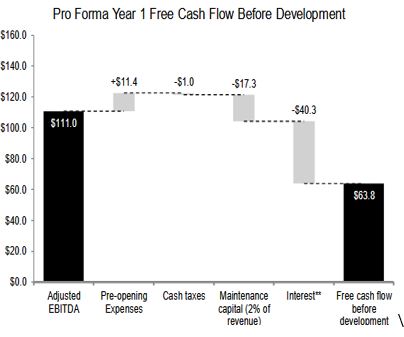
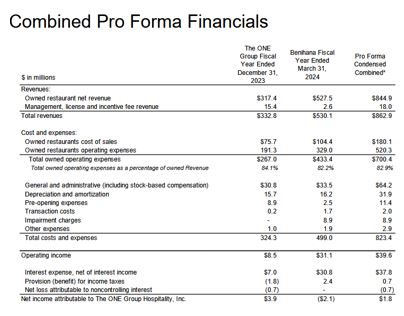
The primary growth vehicles are the continued buildout of STK locations, as well as Benihana, both Company and Franchised. Management has provided a current cash generation picture, excerpted just below from their website’s January ’25 Investment Presentation. It builds in operating numbers from the 2nd chart below: a total revenue run rate of $863M (including $18M from license and incentive fee income, now estimated to be around $15M in ’25), restaurant level EBITDA margin of 17.1%, which could be improved, G&A equal to 5.7% of pro forma system-wide revenues, and corporate Adjusted EBITDA margin of 13.6% after Synergies of Benihana merger.
The two charts below provide a picture of the current (as of 12/31/24) “run rate” of operating margins and cash flow generation.
As of December 31, 2024, the Company had $38.1M in cash and short-term credit card receivables and had $33.6M available under their revolving credit facility. The Company points out that “Under the current conditions, the credit facility does not have any financial covenants.” The Company’s weighted average interest rate on the borrowings under the Credit and Guarantee Agreement as of December 31, 2024, was 11.09%.
Building on the above presented current run rate of cash generation, the Company expects to invest most of the $63.8M of “free cash flow” by adding Company operated units (5-6 Per year, at $4M per unit) as well as gearing up Benihana’s franchise effort and opportunistically building on their asset-light activities. We should point out that $40M of interest expense shown above does not include the 13% preferred dividend on $160M raised to help finance the Benihana acquisition. That obligation, which cannot be refinanced until mid-2027, can be paid out of the Company’s $71M of current liquidity as of 12/31/24 ($38M of cash and $33M unused revolver), paid at least in part out of cash flow, or “paid in kind”, which the Company would add to the “balloon” in mid-‘27. Cash flow from new locations will also contribute cash flow, even if targeted margins take some time to materialize.
THE STK CONCEPT
We present STK first, because it is the brand the Company knows best, and its extraordinary level of profitability has been well established. STK is a steakhouse restaurant, offering a high-energy, fine dining experience, typically in major metropolitan areas. The “Vibe Dining” experience differentiates itself with its chic environment, high quality food and a DJ driven musical atmosphere that encourages social interaction. The restaurants average 10,000 square feet in size. As of December 30, 2023, average AUVs for domestic restaurants open at least 18 months was $17.3M, with an average check of $130 per person. As of December 31, 2024, there were 30 STK locations (19 Company owned, 6 managed, 5 licensed) restaurants. The Company has identified over 75 additional major metropolitan areas globally, which could accommodate 200 locations.
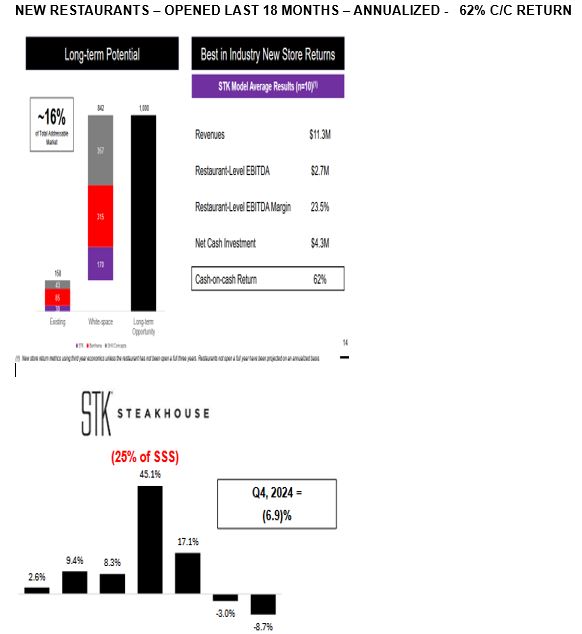
The following chart shows the “best of breed” cash on cash returns, for the previous 10 openings. The second and third charts below shows the impressive same store sales growth since 2017, especially since 2019. Same store sales finally flattened in calendar 2023, declining by 8.7% for all of calendar ’24, improving sequentially in Q4’24 to a negative 6.9%. While still one of the most productive publicly held restaurant chains, management has been pro-active with all aspects of operations to arrest the YTY sales trends and protect margins. As shown by the chart just below, stores opened during the last eighteen months, are annualizing at $11.3M, materially less than $17.3M AUV for stores open for more than three years, but still are tracking toward an impressive 62% cash on cash return, obviously more than enough to encourage continued expansion Since each new location can generate over $2.7M of store level EBITDA, the planned 3-4 new locations each year can add a material $8-10M to the current run rate of corporate EBITDA. The Company sees an addressable market for 200 STKs, so the only limitation on growth for the foreseeable future is the development of operating staff.

THE BENIHANA CONCEPT
Founded in 1964, Benihana pioneered two complementary restaurant brands in the US, providing high-quality food and outstanding guest service. It’s flagship brand, BENIHANA, pioneered interactive teppanyaki dining in the US. RA SUSHI delivers creative sushi and Japanese dishes in a bar-forward, upbeat and vibrant dining atmosphere.
As of 12/31/24 Benihana operated 73 company-owned restaurants and franchises or licenses an additional 11 venues, generating about $575M systemwide. Company operated locations generate $6.5M annually. Run rate EBITDA at acquisition was about $70M. At acquisition management of STKS suggested that $20M of post-closing synergies are possible, over 24 months, bringing the potential incremental EBITDA contribution to as much as $90M.
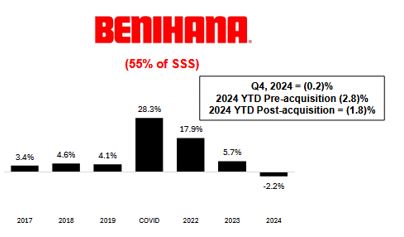
The chart below shows the trend in same store sales since 2019. Similar to STK, but on a smaller scale, Benihana had steady growth prior to Covid, impressive comps coming out of Covid, moderating in ’23, then declining modestly in ’24, with sequential improvement by Q4’24. STKS management feels that AUVs as well as margins can be improved over time, with effective marketing, and a more aggressive bar program, among other operating initiatives.
The Company sees an addressable market for 400 Benihana locations in the US alone, so, just as with STK, there is no shortage of expansion opportunities, for either Company operated and franchised locations.
While AUVs approximated $6.5M (March ’24 Presentation) and the five months ending 9’24 showed a store level EBITDA of 18.9%, which does not include their first and second most profitable quarters (December & March, respectively), we feel comfortable projecting 20% store level EBITDA, or $1.3M against an average $3.75M of capex, which would generate a 35% cash on cash return. This attractive ROI is obviously enough to encourage company store expansion, and the 20% store level EBITDA should be sufficient to attract franchisees. Q4’24 generated store level EBITDA of 22%, 300 bp up from Q4’23.

GRILL CONCEPTS
This division consists of 27 Kona Grill and 16 RA Sushi locations. As described earlier, STKS acquired in October ‘19 (out of Kona Grill’s bankruptcy proceedings) 24 domestic restaurants (about half of the Kona chain at its peak), for a contractual price of $25.0 million plus approximately $1.5 million for the apportionment of rent and utilities and approximately $7.7 million in current liabilities. At this point, though comps and profit margins have been challenged in the last year or so, Kona Grill has more than paid for itself. More recently – 20 RA Sushi locations were purchased (four of which have since been closed), along with the acquisition of Benihana.
As described in the STKS 10K filing, Kona Grill is a bar-centric concept, featuring steaks, seafood, award-winning sushi and specialty cocktails in a polished casual atmosphere. The full-service bar offers a broad assortment of wines, craft cocktails and beers. The locations are spread among 18 US states, averaging 7-8k square feet. The Kona AUV was $5.2M in ’23, with an average spend per transaction of $63.
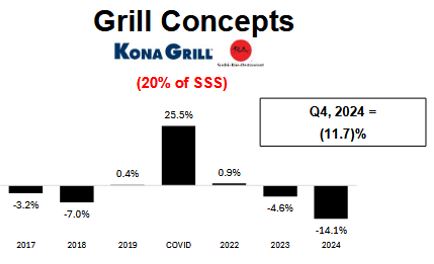
As shown in the chart below, same store sales were down 4.6% in calendar ’23, down a further 14.1% in ’24, though Q4 improved sequentially to a negative 11.7%. Store level EBITDA in calendar ’23 was 9.3% of sales, down from 10.8% in ’22. At this point, while the Grill Concepts division remains cash flow positive, the Company obviously is applying its capital and expansion effort toward Benihana and STK.

ONE Hospitality – F&B Hospitality Management Services
ONE Hospitality includes developing, managing and operating restaurants, bars, rooftop lounges, pools, banqueting and catering facilities, private dining rooms, room service and mini bars tailored to the specific needs of high-end hotels and casinos. F&B hospitality clients operate global hospitality brands such as the W Hotel, ME Hotel, Hippodrome Casino, and Curio Collection by Hilton. For those restaurants and venues that are managed or licensed, management fee revenue based on top-line revenues and incentive fee revenues based on a percentage of the location’s revenues and net profits.
CASH FLOW MODEL – THREE YEARS OUT
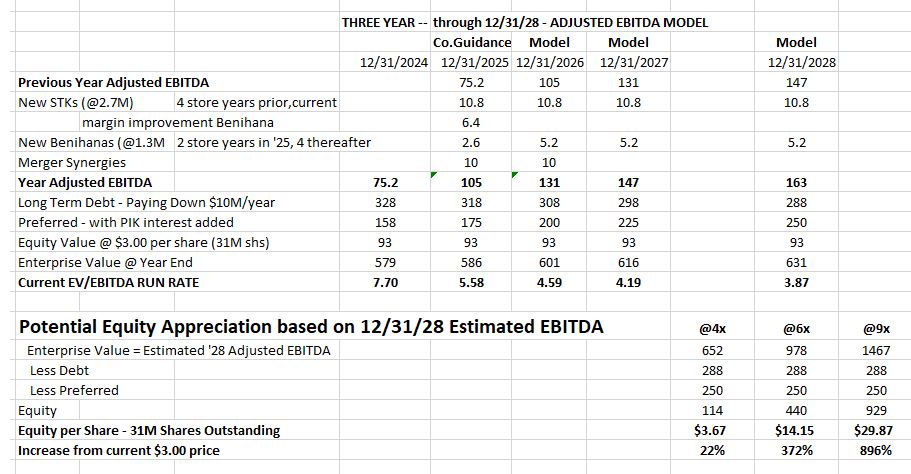
As Yogi Berra might have said: “Projections are always difficult, especially about the future”, but the following is our broad-brush model that describes The ONE Group’s possible next three years of progress. We are starting with (1) the midpoint of company guidance for calendar ’25 EBITDA ($105M) after pre-opening expenses) (2) assuming that store level returns are maintained and new stores match them (3) Company annually adds 4 Company STKs and 4 Company Benihanas (5) assumes no material contribution from Benihana franchising (6) assumes no margin improvement at company operated Benihana locations, though Q4’24 showed 300bp of improvement and each 100bp change represents about $5M annually (7) assumes that the $350M of 11% debt is reduced modestly (by $10M per year) (8) assumes that the current $160M of 13% Preferred Stock grows to about $225M due to the Paid in Kind interest.
This is rough, admittedly, and we believe conservative, but demonstrates that over three years, the Adjusted EBITDA Run Rate could grow from $105M estimated in calendar ’25 to $163M in calendar ’28. Today’s Enterprise Value is 3.87x that possibility, and an investor can judge what multiple the market will place on that $163M three years from now. Taking that Adjusted EBITDA out another couple of years would obviously put it close to $200M, approximately double the current rate.
And the stock price could be..…….
We have calculated the potential stock price with an Enterprise Value at 4x, 6x,and 9x the 12/31/28 modeled EBITDA. Du to the financial leverage, the stock price appreciation (from $3.00 per share) at 6-9x EV divided by EBITDA would be from 372% to 896%. Even at only 4x EBITDA, presumably unlikely if the Company progresses as modeled, a modest 22% profit (from $3.00/share) would be the result. To be sure, leverage works both ways. Our conclusion is that, based on the various elements discussed above, the risk of disappointment is comparatively low, and there is a possibility that our fundamental upside model could even prove conservative.
CONCLUSION: Provided at the beginning of this report