



Bloomin’ Brands (BLMN)
Prologue:
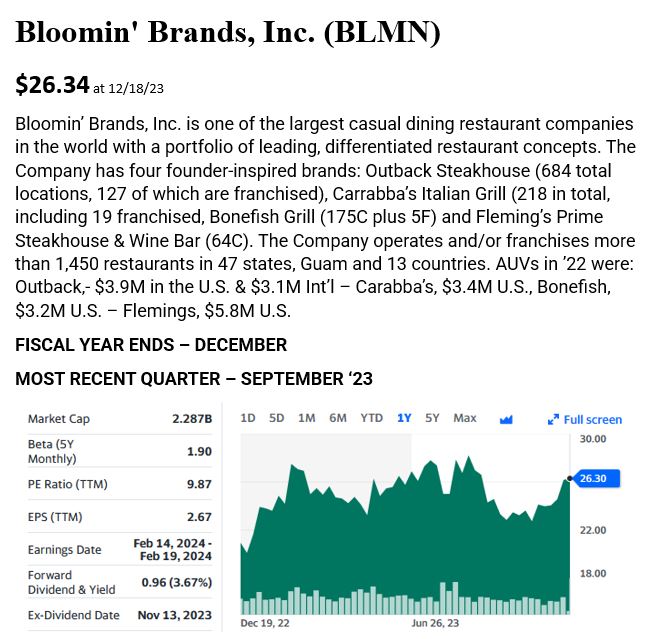
Earlier this month we wrote a report that highlighted four restaurant companies whose fundamentals could be close to an inflection point in their business, one of those being Bloomin’ Brands, Inc. (BLMN). The combination of a low valuation and “lots of ways to win” has attracted an activist, namely Starboard Value, L.P. now with 10% ownership, who has previously had notable success within the restaurant industry. After a summary of the state of the Company we will describe (1) the attractive valuation metrics, (2) discuss a number of the potential upside opportunities, and (3) reference Starboard’s history within the restaurant industry. For those readers with a very short attention span 😊, we consider BLMN common stock to have an unusually attractive reward/risk profile.
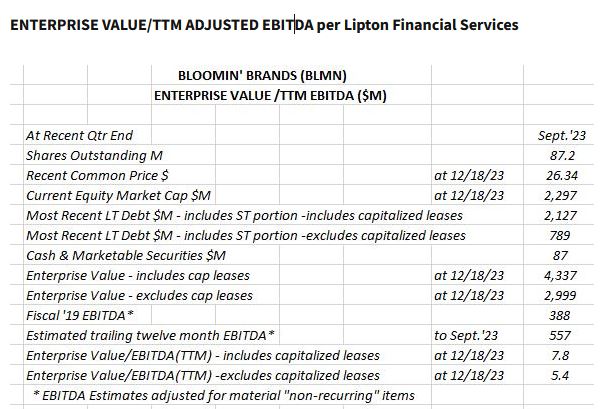
CONCLUSION: Bloomin’ Brands owns a number of well-known brands whose combined value, we believe, is under-stated by BLMN’s current Enterprise Value. Starboard Value LP has taken a 10% stake and suggested that a great deal of operational improvement is possible. In that regard they have hired a highly qualified consultant, fresh from an outstanding career at Best of Breed Darden Restaurants. Even if currently “undermanaged”, BLMN is generating over $500M of cash flow, several hundred million of which is “free”, available for renovations, technology capex, product development, stock buybacks, increased dividends, unit expansion or acquisition, or, needless to suggest to private equity firms, debt service. In regard to current debt, the balance sheet is relatively unleveraged, with long term debt at only about 1.5x TTM EBITDA. Management, on their own and/or encouraged by Starboard suggestions, is working at improving US store level operations, as well as exploiting opportunities at Outback/Brazil or other brands (Carrabba’s, Bonefish and Fleming’s). Selling at 5.4x trailing twelve month Adjusted EBITDA, there are seemingly a lot of ways to win. For each “turn” above 5.4, shareholders would receive about $6.40/share (or 24% of the current stock price). We believe the current stability, the strong balance sheet, and the potential for improvement conservatively justifies at least 8x trailing EBITDA, equating to a 61% gain from today’s $26.34 per share.
THE COMPANY
The following is the BLMN “Company Detailed Analysis” similar to that which we provide on our coverage of over 50 publicly held restaurant companies and 9 non-restaurant franchisors. EXPANDED REPORT BEGINS WITH SECTION MARKED “VALUATION” BELOW
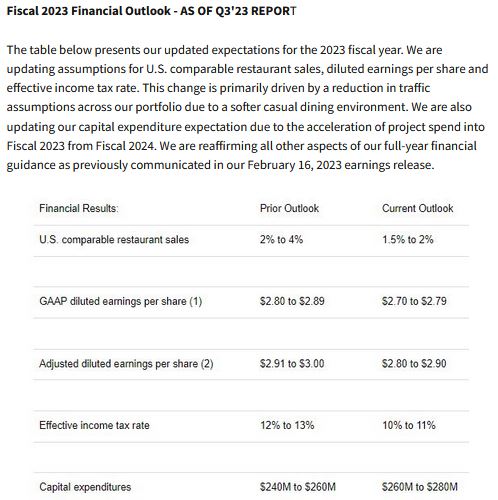
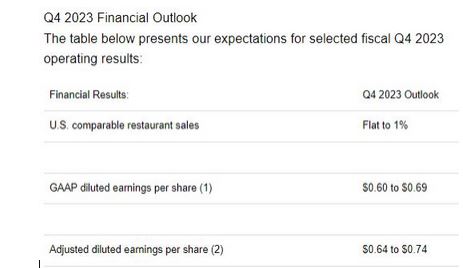
MOST RECENT CONFERENCE CALL TRANSCRIPT
https://seekingalpha.com/article/4647840-bloomin-brands-inc-blmn-q3-2023-earnings-call-transcript
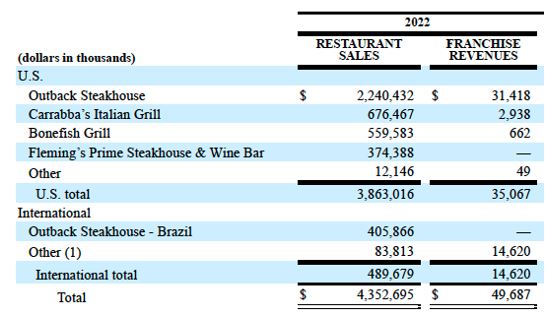
EXPANDED REPORT FOLLOWS
STOCK OF THE MONTH – DECEMBER ’23 – BLOOMIN’ BRANDS (BLMN)
THE VALUATION
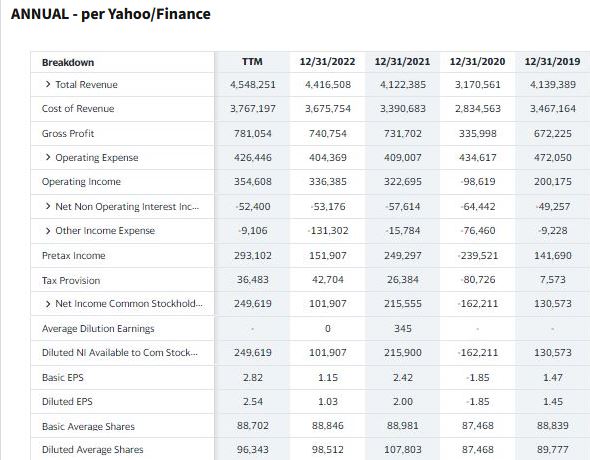
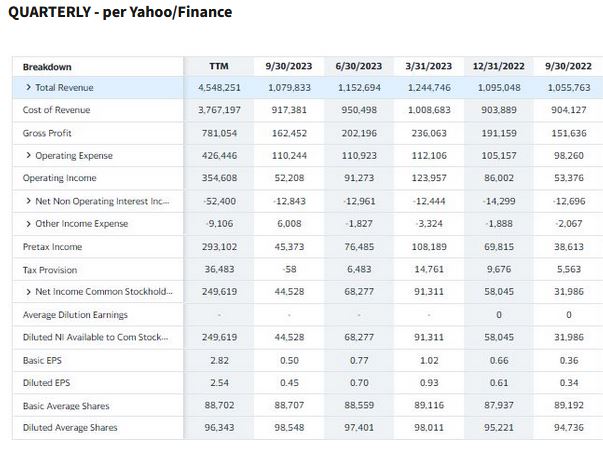
The following charts (augmenting our presentation above) show the result, in terms of valuation, of BLMN’s recent relatively disappointing operating margins (to be discussed later). TXRH and DRI trade at approximately twice the EV/EBITDA value of BLMN, while BLMN (undervalued as it is) has a much higher “cash flow yield”.
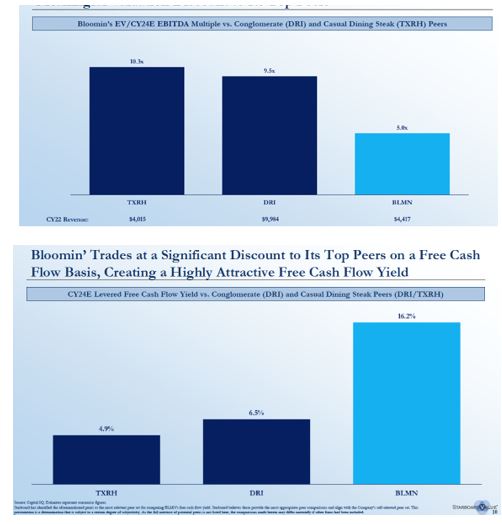
It is pertinent to a valuation discussion that free cash flow generation since 2015 has allowed for repurchase of about 50% of the shares then outstanding. 20% of which bought since 2020, and that process continues. In the most recent nine months, $61 million has been spent, at an average price of $25.41(only 5% below the current price) and $79M remains under the current authorization. Also worth noting is the $0.24 quarterly dividend, providing a 3.6% current yield.
OPERATIONAL CONSIDERATIONS
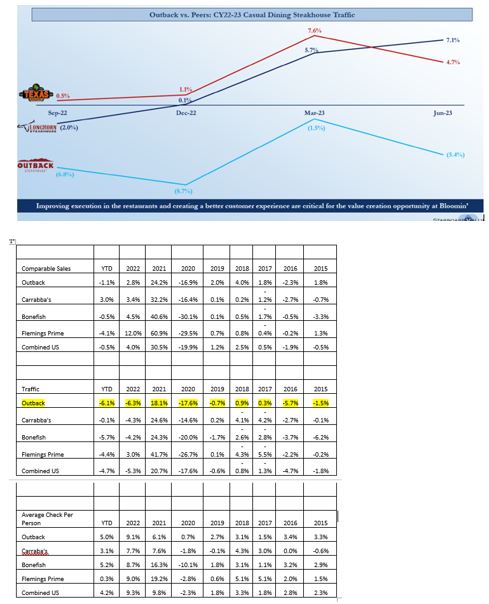
Operating margins have been flat since 2015 and, as the chart below shows, traffic has been much weaker than at peers (DRI and TXRH). Per the second chart below, the weakness in guest traffic has been occurring for a long time (6 of the last 9 years have seen negative guest traffic). The key to any sustainable turnaround in a restaurant company has to be increasing guest traffic, an obvious challenge these days. The relative success of Texas Roadhouse and Longhorn Steakhouse in recent years, also with average checks in the $25-30 range, is no doubt for good reason and it will be difficult for Outback Steakhouse, and the other Bloomin’ Brands to recapture the lost guests
STARBOARD VALUE KNOWS RESTAURANTS
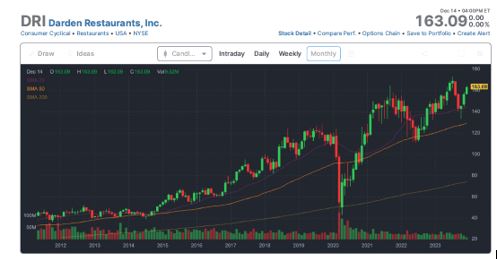
Starboard Value L.P.’s recent acquisition of nearly 10% of the company’s shares should be source of comfort and optimism for investors. Starboard Value has a track record of successfully turning around struggling restaurant chains. In 2014, Starboard Value acquired approximately 10% of the shares of Darden Restaurants. Though “only” controlling 10%, Starboard convinced shareholders to replace the entire Board and elect Jeffery Smith as CEO. For those interested in seeing the original proposal for turning around Darden in 2014, you can download the 294 page PDF here. The turnaround plan (including creating a public REIT to hold Darden’s real estate (Four Corners Property Trust: FCPT) proved successful and Darden is now considered a premier operator in the casual dining industry.
In February of 2019, in the wake of corporate problems involving founder, John Schnatter, Starboard purchased $250M of convertible preferred stock in Papa John’s (PZZA). The closing price of the stock at the time of the investment was $38.51 per share (for about 4.8M shares), with the conversion price in the low 50s. On an as-converted basis, subsequent to that purchase Starboard owned from 11-15% of PZZA and Starboard CEO Jeffery Smith was appointed one of three new directors. Within the last two years, the position has been liquidated by Starboard at a double or better on their investment, including 2.1M shares sold back to the Company and Jeffery Smith resigned from the Board, effectively ending his involvement in the company.
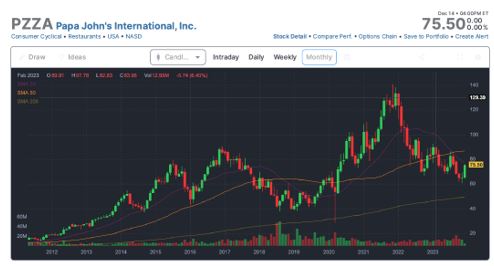
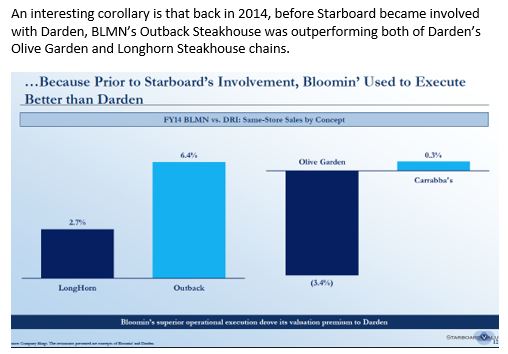
The key question at this point is whether Starboard can do a Three-Peat with Bloomin’ Brands. It is worth noting, per the below chart, that Bloomin’ used to do better than Olive Garden.
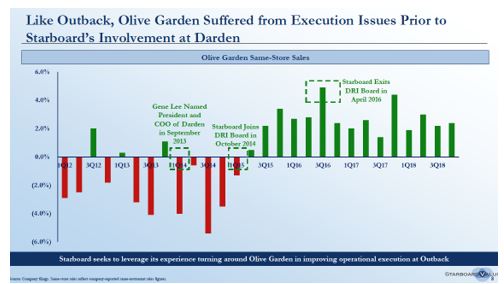
THE UPSIDE POSSIBILITIES – Multiple “WAYS TO WIN” – with an “ace in the hole.”
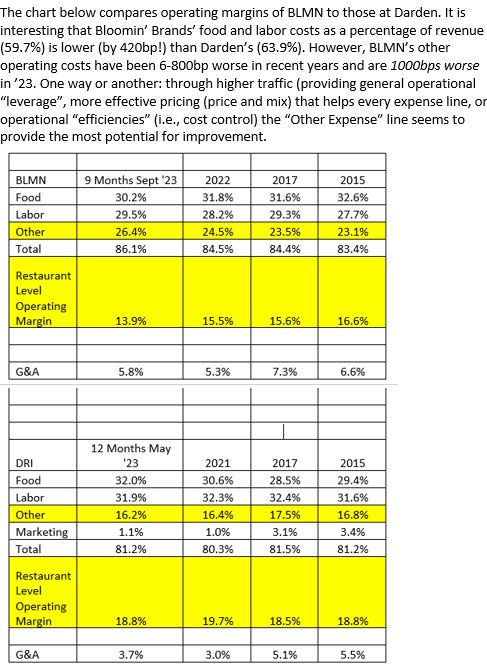
As discussed above, store level margins have substantial room for improvement, and better traffic, difficult as that may be, would help greatly. An important “ace in the hole” is the reported hiring (by Starboard) of David George as a consultant to analyze opportunities for improvement. David George was at Olive Garden when Starboard got involved, was President after ten years there, then spent five years as President of Darden’s Longhorn Steakhouse chain. Having spent at least fifteen productive years with Best of Breed, Darden Restaurants, it stands to reason that he will have a few thoughts.
Substantial Cash Flow with Modest Debt = financial flexibility
Over the last twelve months, BLMN has generated about $550M in Adjusted EBITDA, which is about 25% of its current equity market capitalization, an 18% return on Enterprise Value excluding capitalized leases, and almost 13% including capitalized leases. Roughly half of that has been spent on capital expenditures. Wall Street analysts expect free cash flow to rise to $338M next year, which would be a 15% yield on the equity value of the company, one of the highest in the industry. It is worth noting that hardly any properties are owned “in fee”, so sale-leasebacks are not a material opportunity in this case. On the other hand, with long term debt at only about 1.5x TTM Adjusted EBITDA, the balance sheet is very modestly leveraged.
Current Priorities – as stated by Management
Per the Q3’23 conference call:
“In the long term, we are committed to the strategic priorities that are making us a stronger, leaner operation-centric company. These priorities include: first, driving in-restaurant same-store sales growth, and this is our top priority; second, increasing new restaurant openings while refreshing our existing assets; third, maintaining our off-premises momentum; fourth, becoming a more digitally-driven company; and finally, investing in technology to drive growth while preserving margins.
“We think one of the best ways to give guests a reason to return to the brand is to continue to refresh the store base. Both Outback and Carrabba’s brands were started in the late 1980’s, which means that some of the store base is most likely in declining trade areas and will need major improvements to drive sales to those stores. Casual dining companies with 30+ years of operating history such as Darden and Brinker International, as well as fast food companies McDonald’s and Wendy’s, have been successful in staying relevant by refreshing their assets to remain competitive as younger brands continue to expand. We like the fact that the company can invest in the business to make needed changes without leveraging the company.”
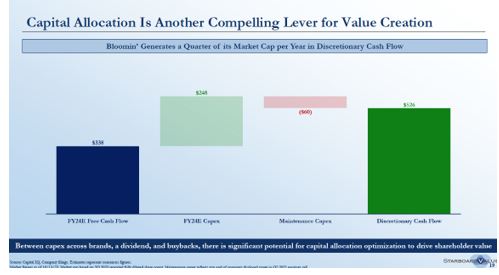
The Case for Revived Unit Growth
Growth is good but management and Starboard are too smart to push unit expansion before operational issues are resolved. If the existing locations are not operating at an optimal level, adding stores becomes an additional distraction for management and typically leads to destruction of capital as new stores quickly succumb to the same problems as the older stores. Realistically, as long as BLMN remains publicly traded, it will not receive a valuation closer to TXRH or DRI only by improving its margins and/or reversing the negative traffic trends, though positive traffic would likely be a harbinger of better margins to come. Fortunately, in the meantime there are a few levers that BLMN management can employ to please investors awaiting longer term progress.
Carabba’s Has a Long Runway for Growth
Even though Carrabba’s is the second largest Italian casual dining concept in the USA by unit count, it has only 20% of the number of stores as Olive Garden. As we showed in a previous table Carrabba’s same-store sales have outperformed Outback Steakhouse by a significant amount. We believe this concept could be an important growth vehicle going forward. Alternatively, Carabba’s could be monetized in some fashion, allowing for further BLMN stock buybacks, a larger dividend, and/or unit expansion at Outback or other brands when appropriate.
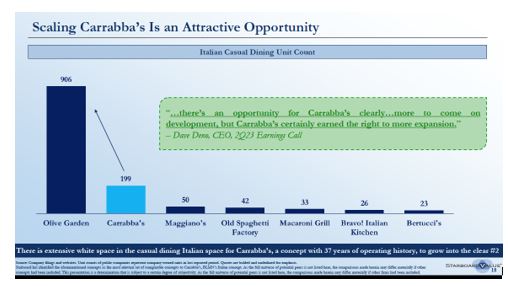
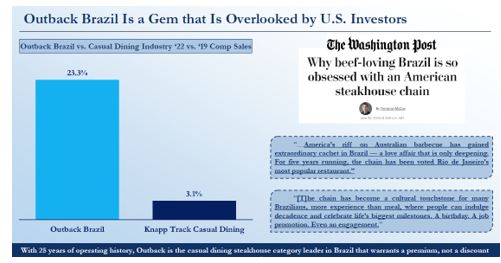
Outback Brazil is Valuable
Outback Brazil, in terms of same store sales over the last several years, is by far the best performing segment within all of BLMN brands. The chain currently has only 154 units, averaging $3.3-3.4M annually, so it has substantial room to grow in both Brazil and other Latin American countries. It appears that Outback Brazil is could be a valuable growth vehicle or spun out of the company to monetize its value.
CONCLUSION: Provided at the beginning of this report:
Prepared by: Roger Lipton, Founder & Chairman, Lipton Financial Services, Inc.