

Follow The Money 8/15/26
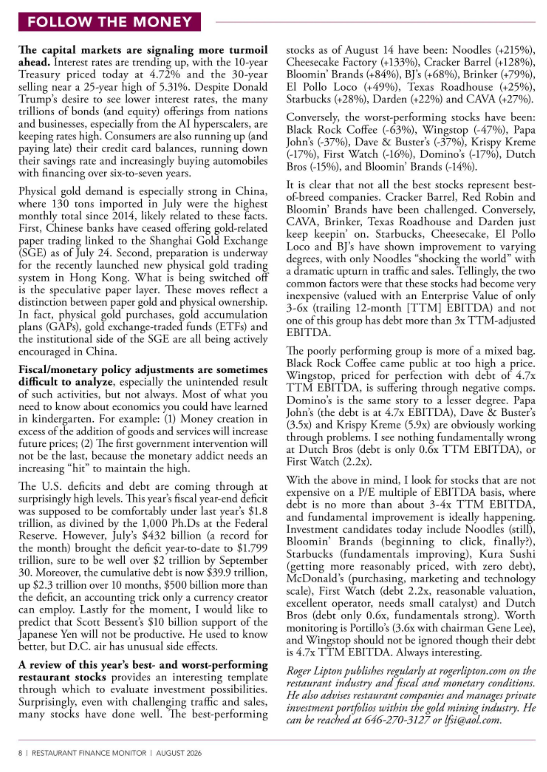
The capital markets seem to be signaling more turmoil ahead. Interest rates are trending upward, with the 10 year Treasury priced today at 4.68% and the 30 year just selling at a 25 year high of 5.5%. It’s no wonder that interest rates resist Donald Trump’s desire to see them lower, considering the many trillions of bonds (and equity) offerings from nations and businesses (especially the AI “Hyperscalers”.) The individual consumer is also participating, running up (and paying late) his credit card balances, running down his savings rate, increasingly buying automobiles over 6-7 years and shying away from new home purchases with burdensome mortgage rates. Central Banks, after continuing their record buying in Q2’26, expect prices to be higher 6-12 months from now, and (importantly) expect to continue buying. Physical gold demand is especially strong in China, where 130 tons imported in July were the most monthly since 2014, likely related to the facts that (1) Chinese banks have, as of July 24th, ceased offering gold related paper trading linked to the Shanghai Gold Exchange and (2) preparation is underway for the recently launched new physical gold trading system in Hong Kong. What is being switched off is the speculative paper layer. These moves reflect a distinction between leveraged paper trading and physical ownership. In fact, physical gold purchases, gold accumulation plans (GAPs), gold exchange-traded funds (ETFs), and the institutional side of the SGE are all being actively encouraged in China. The gold reserve strategy of the People’s Bank of China (PBOC) remains in play as well.
Fiscal/monetary policy adjustments are sometimes difficult to analyze, especially the unintended result of such activities…..but not always. Most of what you need to know about economics you could have learned in kindergarten. For example: (1) Money creation in excess of the addition of goods and services will increase future prices and (2) The first government intervention will not be the last, because the (monetary) addict needs an increasing “hit” to maintain the high. The US deficits and debt are coming through at “surprisingly” high levels. This year’s (9/30/26) deficit was supposed to be comfortably under last year’s $1.8T, as divined by the 1000 PHD’s at the Fed, but July’s $432B (a record for the month) brought the deficit YTD to $1.799T, sure to be well over $2T by September 30th. Moreover, the cumulative debt is now $39.9T, up $2.3T over ten months, $500B more than the deficit, an accounting trick only a currency creator can employ. Lastly for the moment, we would like to predict that Scott Bessent’s $10B support of the Japanese Yen will not prove productive. He used to know better, but D.C. air has unusual side effects.
A review of this year’s best and worst performing restaurant stocks provides an interesting template through which to evaluate investment possibilities. Surprisingly, even with challenging traffic and sales trends in 2026 to date, many stocks have done well. The best performing stocks, in order as of 8/12, have been: Noodles (+190%), Cheesecake -(+133%), Cracker Barrel (+131%), Red Robin (+101%), Bloomin’ Brands (+84%), BJ’s (+73%), Brinker (+71%), El Pollo Loco (+45%), TX Roadhouse (+29%), Starbucks (+29%), Darden (+23%), CAVA (+18%).
Conversely, the worst performing stocks have been: Black Rock Coffee (-63%), Wingstop (-53%), Papa John’s (-37%), Dave & Buster’s (-36%), Dutch Bros (-17%), Krispy Kreme (-17%), First Watch (-16%), Domino’s (-15%) & Sweetgreen (-14%).
First, it is clear that not all the best stocks represent “best of breed” companies. Cracker Barrel, Red Robin and Bloomin’ Brands have been challenged. Conversely, CAVA, Brinker, TX Roadhouse and Darden just keep keepin’ on. Starbucks, Cheesecake, El Pollo Loco and BJ’s have shown improvement to varying degrees, with only Noodles “shocking the world” with a dramatic upturn in traffic and sales. Tellingly, the two common factors were that the stocks had become very inexpensive (valued with an Enterprise Value of only 3-6x TTM EBITDA) and not one of this group has debt more than three times TTM Adjusted EBITDA.
The poorly performing group is more of a mixed bag. Black Rock Coffee came public at too high a price. Wingstop, priced for perfection with debt of 4.7x TTM EBITDA, is suffering through negative comps. Domino’s is’ the same story to a lesser degree. Papa John’s (Debt at 4.7x EBITDA), Dave & Buster’s (@3.5x) and Krispy Kreme (@5.9x) are obviously working through problems. We see nothing fundamentally wrong at Dutch Bros (Debt @ only 0.6x TTM EBITDA, or First Watch (@2.2x).
With the above in mind, we look for stocks that are not expensive on a P/E multiple of EBITDA basis, where debt is no more than about 3-4x TTM EBITDA, and fundamental improvement is ideally happening. Investment candidates TODAY, include Noodles (still), Bloomin’ Brands (beginning to click, finally?), Starbucks (fundamentals improving), Kura Sushi (getting more reasonably priced, with zero debt), McDonald’s (purchasing, marketing and technology scale), First Watch (debt 2.2x, reasonable valuation, excellent operator, needs small catalyst), and Dutch Bros (debt only 0.6x, fundamentals strong). Worth monitoring is Portillo’s (3.6x with CEO Gene Lee), and Wingstop should not be ignored though their debt is 4.7x TTM EBITDA. Always interesting.
Roger Lipton