


ON MARCH 11, 2019 WE WROTE:
THE FRANCHISOR/FRANCHISEE ECONOMIC RELATIONSHIP – IT’S A NEW WORLD!!
Almost everybody has noticed that there is an increasing strain between franchisees and their franchisors. It is no accident that new franchisee associations are being formed and existing organizations are getting more militant. There are many intangible reasons, as too many franchisors do not treat their “z’s” as partners. We have written many times that the “asset light”, “free cash flow” model is not reflecting the necessary investments in the system to keep franchisees as profitable as possible. Many franchisees are especially bothered by the fact that their franchisors are spending hundreds of millions, sometimes billions, of dollars buying back stock and making acquisitions, while leaving the franchised operators without the necessary new product development, technology upgrades, marketing initiatives, etc.etc.
With all of that in mind, the bottom line is the bottom line. Too many franchisees are suffering financially, under more pressure than ever. The typical franchise royalty is 5%, give or take a point, plus 2%, as an advertising contribution. There are often additional charges, not all that material in and of themselves, but adding to an already large burden. Let’s say the franchisee is fortunate enough to be making 17-18% store level EBITDA (and Depreciation is not free cash in the long run). Rebating 7 points out of 17 or 18 points starts to feel like a pretty big load, and there is still local G&A to be carried. Even if store level EBITDA, before royalties, is in the low twenties, 7 points gets to be a bother. Additionally: many franchisees, Dunkin’ Donuts and Burger King and Jack in the Box are just a few examples of mature systems where decent money is still being made at the store level because the store leases were signed ten or fifteen years ago, so occupancy expenses are lower than today’s economics would allow. That’s, of course, why so few new units are being built by many mature franchised systems, especially in the USA. Today’s economics do not allow it.
When Ray Kroc started franchising McDonald’s restaurants over 60 years ago, the royalty was 1.9%. By the 1960s, franchisors had started charging 2-3%, by the 1970s 3-4%, by the eighties 4-5%, and 5% seems to be the standard today, plus advertising and other fees.
At the same time, there are no material expenses that are lower, as a percentage of sales, certainly not occupancy expenses or labor, and food costs are unpredictable commodities. The biggest single negative trend, that nobody would debate, is the immense competition that has become commonplace. Even in today’s over-stored situation, there are more new stores being built, within chains, than closing. This competitive pressure has also created the need for far more support from the franchisor, if the increasingly critical public is to be satisfied and the franchisee partner is to succeed. Over the last fifty years, as the franchisor should be providing more support and burdening the franchisee less, the trend has been just the reverse.
The answer: lower fees, especially ongoing royalties.
This specific suggestion will not be adopted by existing large chains, because it would be such an obvious reduction of the current royalty stream. However, well established franchisors could, and should, absorb more of the additional system-wide needs, such as technology upgrades. “Mid-stage” franchising companies could put some part of the following suggestions in place.
If I were running an early stage franchising company, I would put in place a sliding scale royalty system, charging 2.5-3.0% at a modest sales level, higher if the franchisee does better. Give them a little room to make money if the store doesn’t do quite as well as everybody hopes. If the store clicks, everybody is happy and 4-5% on the higher sales won’t seem like such a burden. For my multi-unit franchisees, I would charge lower upfront fees for development of 2nd, 3rd and additional stores, and this is sometimes already being done (whether admitting it to Wall Street or not). This is logical and appropriate, because less franchisor support is required as a franchisee builds local infrastructure.
It seems likely that a young franchising company adopting this strategy would have a huge competitive edge and the total royalty stream is likely to build more rapidly using this progressive approach. Profitable franchisees, and a more appropriate sharing of store level profits in today’s economic reality, make for a successful system in the long run.
FIVE YEARS LATER
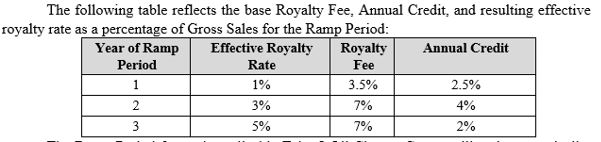
SO……in early March, 2024, DRIVEN BRANDS (DRVN) OUR CURRENT “STOCK RECOMMENDATION OF THE MONTH” is being “driven” (forgive the pun) by the success of their Take 5 Oil Change franchise. They have brilliantly put to use our suggestion above: “a sliding scale royalty…from 1% in year 1 to 5% in year 3, after rebates that are contingent based upon performance.
The result is that Driven Brands’ Take 5 Oil Change brand, grew franchised units by a cool 50% in ’23, from 200 to 300 units, and expects to grew by at least 33% in ’24, from 300 to over 400 locations.
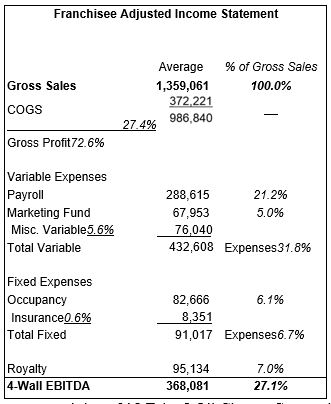
Most important…….the unit level economics are attractive, or none of it would work. Roughly – the franchisees make a cash-on-cash return of 20% in year one, about 30% in year two, 40% and more thereafter. The excerpts that follow, from the very informative Franchise Disclosure Document (quoting calendar ’22 numbers) clearly explain why this extraordinary growth is taking place.
“For Take 5 Oil Change Centers opened within 3 years from the date you sign the applicable Area Development Agreement, during the first 36 months following the Opening Date (the “Ramp Period”), we will pay you, on an annual basis within 45 days after the end of each 12-month anniversary of the Opening Date, an annual credit calculated as a percentage of Gross Sales for the Take 5 Oil Change Center (the “Annual Credit”), provided that you and your affiliates are in material compliance with the Development Schedule, the standards of operation in the Manuals, our training programs, and any and all franchise agreements between us and/or our affiliates and you and/or your affiliates. For the first 12 months of the Ramp Period, the Annual Credit is 2.5% of Gross Sales; during the second 12 months of the Ramp Period, the Annual Credit is 4% of Gross Sales; and during the third 12 months of the Ramp Period, the Annual Credit is 2% of Gross Sales.”
FRANCHISEE GROSS SALES AND CARS PER DAY
A. Gross Sales and Car Per Day (CPD) Ramp for Years 1-3
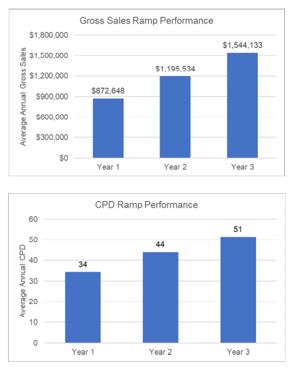
Part II. A of this financial performance representation reflects the historical average and historical median ramp of annual Gross Sales and number of cars per day (“CPD”) serviced by the Take 5 Oil Change Centers owned and operated by our franchisees over the first 3 years of operation. We included in the charts below the results of all 130 Take 5 Oil Change Centers that have opened since we and our predecessor began offering franchises for Take 5 Oil Change Centers (with the first franchised Take 5 Oil Change Center opening on December 5, 2017) through December 25, 2021.
THE RESULT – UNDERSTANDABLE, SUSTAINABLE, EXPANDABLE – and COMFORTING FOR INVESTORS
Understanding that the above discussion applies to only one segment of DRVN, “Maintenance”, this represents over 60% of corporate segmented Adjusted EBITDA, the most rapidly growing and (we believe) the most predictable portion.
Take 5 Franchisees are strongly incentivized, by way of royalty rebates during the first three years, to meet operating standards as well as development schedules. Supported by the underlying strong unit level economics, it becomes clear why 100 franchised locations opened in ’23, on a base of 200, and 100 or more will open in ’24.
It is also understandable why the Company continues to build on their base of 700 company operated locations. The company operated cash on cash return, with no royalties to pay, is somewhere between 30 and 40 percent in year one, and sharply higher thereafter. With their substantial balance sheet and EBITDA north of $500M, sale/leaseback transactions can leverage the returns to well over 100% annually.
Royalties from 300 franchised Take 5 locations (an average of 250 for ’23), with an average royalty of 3% of $1.2M calculates to a modest $9M, out of over $300M of segment EBITDA. (We have not included up front franchise fees in this discussion, which are additive.) Our projections indicate that ongoing royalties could be at a run rate approximating $40M annually by the end of calendar ’26 and double again in the following three years.
The largest contribution to the “Maintenance” segment within Driven Brands comes from an average of 675 company stores, averaging perhaps $1.35M with store level EBITDA of 28% (let’s say), which calculates to $255M. The good news is that franchise royalties will grow very rapidly, from what we call a “two-way ramp”, an increasing royalty rate on top of the maturing store sales. At the same time, DRVN can well afford to build an additional 50 company stores/year, which will be building over three years to a store level contribution of about 30% of $1.5M, or $22.5M of store level EBITDA. This rough model shows how predictable and substantial the Take 5 segment of Driven’s broader base will become.
Those of us that have long followed restaurant companies know that the first year revenues most often reflect a honeymoon period, the second year is usually lower, and the hope is that year three will build back, with an objective of equaling or exceeding the first year. In the case of the Take 5 franchising effort, the natural three year “build” of revenues, cash flow, and royalties to DRVN, seems very comforting to this investor. Nothing goes straight up forever, but these openings are modestly profitable to begin with, highly likely to build materially (from $872k to 1.544k) over years two and three, and further from there with inflation and marketing efforts. By the end of year three, the franchisees seem likely to have recouped their entire investment and will be therefore “playing with the house money.” In the meantime Driven Brands will be reporting steadily increasing earnings and cash flow, and the stock will likely be revalued to a much higher level.
Roger Lipton