


The capital markets for stocks and bonds were consistently weak in September, picking up steam in October as investors in stocks and bonds show their concern about the Fed’s message of higher-for-longer interest rates.
It’s been said that crises develop very slowly and then very quickly. That may be what we are about to witness. The benchmark 10 year Treasury yield reached a 16 year high last week and the thirty year bond did the same just yesterday. Even gold bullion has not been a safe haven lately, down about 5% in September and gold mining stocks were down about twice that. The timing of lower interest rates to come is uncertain but ongoing inflation accompanied by a new historically large round of monetary easing is predictable for reasons indicated below.
The US debt hit $33T, with one trillion added in 90 days. It took a little longer, over 200 years, to build the first trillion of debt when Ronald Reagan was President. A dollar in 1913, when the Fed was established to control inflation, is worth under $.02 today. So much for the Fed’s mandate back in 1913 to control inflation.
Consider the following “anecdote”. I was one day late on my American Express monthly payment (in full), and they socked me with a full month’s interest, at 25.4%. They waived the charge when I called and complained, but as a decades long American Express card holder, that did not make me happy or encourage me to run up a bigger balance. People – 25.4% interest (at American Express, not a low life lender) is a rate that will attract attention and restrict spending.
More broadly: interest rates cannot go much higher because, among other things: (1) Consumer credit card debt hit a historic high of $1 trillion and the average interest rate on those balances is over 20% (25.4% at AMEX) (2) Mortgage rates are almost 8%, more than twice two years ago, affecting home sales and car sales, two important portions of our economy (3) Unrealized losses on bank fixed income HTM (Held to Maturity) portfolios continues to restrict bank lendng. The $309B of HTM securities within the US banking system as of 6/30 will no doubt be materially higher as of 9/30, so new writedowns will hit the headlines sometime soon, and this will not provide comfort to investors or consumers. (4) Interest on the US debt is already approaching one trillion dollars, moving consistently higher as the current debt rolls over at higher interest rates. The continuing debt buildup, financed at 5% or thereabouts will take that number to two trillion within 3 or 4 years. (5) Leading economic indicators show a stagnant economy, at best. (6) Observers are starting to ask who is going to buy the huge amount of US Treasury securities, approaching $10 trillion to be issued within 12 months or so, combining the $2 trillion current deficit and about $7 trillion that will mature and have to be refinanced. Especially with the Chinese, the Japanese and others pulling back, the question can be asked “to whom?”.
That will leave the Fed as not only the buyer of “last resort” but “the only resort”, unless interest rates are much higher. The government and the supposedly independent Fed, once again, have a choice between much higher interest rates (to kill inflation), bringing on a serious recession (or depression), or a new round of monetary ease to protect the economy. The political dance will go on, but the politicians don’t have the will to administer the necessary fiscal and monetary medicine.
We predict that the impotence of the Fed will be on full display as capital markets (including the so-called “bond vigilanties”) take control. By the time the economic turndown is on full display, with interest rates surging to attract buyers of corporate, municipal and federal securities, the new round of monetary ease will have to be even larger than in the past. After all, it takes a larger and larger “fix” to maintain the addict’s “high”
A LIKELY SAFE HAVEN – FINALLY!
Our readers know that we have long favored gold mining stocks, as a leveraged way to participate in the inevitable long rise in the price of gold bullion. We’ve been correct in anticipating a rise in the price of bullion, but the mining stocks, as shown below, have substantially lagged. Paper currencies continue to be destroyed and that is why Costco has started selling 1-ounce gold bars, which the Company said last week are limited to two per customer and are selling out in a matter of hours. Central banks continue their accumulation, led by our two largest adversaries Russia and China, who would like nothing more than to see a weaker dollar and higher gold price. Physical gold bullion has been trading recently at a $100 per ounce premium in China.
The chart below shows the ratio of the Philadelphia Gold and Silver Index (consisting of 30 gold and silver mining stocks) to the price of gold.
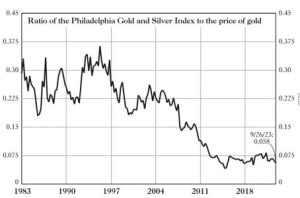
You can see that the current ratio of about .06 is only about 25% of .25 that was the mean from 1983 to 2004. Even at the bottom of the range (.18) the mining stocks would be three times higher than they are currently. If they triple (to catch up) then quadruple as gold doubles over the coming years, that would be twelve times the current level. Just sayin’.
Roger Lipton